

Large-Format Film in the Quarries of North Wales
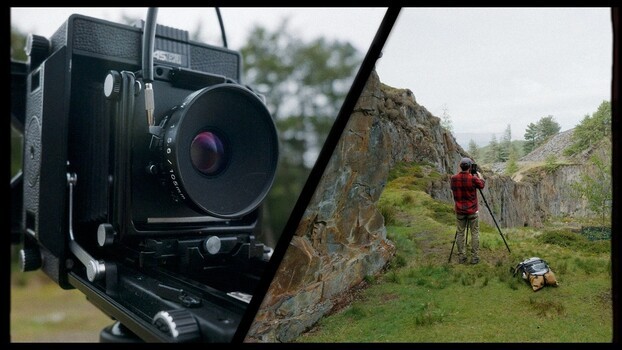
Abandoned slate quarries hold more than dramatic scenery. Some hide names carved into stone over a century ago, tools left where workers dropped them, and connections to people you'd never expect.
Kyle McDougall returns to North Wales for a second day of shooting, this time about an hour south from the large quarry in his previous outing, and he walks through two smaller sites that opened around 1850 and ran until roughly 1920. The lower one was a mine, the one beside it an open-cast quarry, and the density of relics here surprised him. Massive waste tips spill down toward a view across the bay. Old cutting tools sit out in the open, still where they were left. He shoots film throughout, exposing Ilford HP5 for the green foreground grass at an eighth of a second and f/27, letting the dark slate incline fall about two stops under.
The standout find is the Blue Lake, a flooded quarry pit with deep turquoise water that once served as a local swimming spot before the landowner filled in the tunnel access. Digging through old history documents, McDougall came across a line about a McDougall's engineer flooding the pit, which led him to Sir Arthur McDougall, the flour magnate whose brand you can still buy in the UK today. McDougall bought the land that became Fairbourne, the seaside town below, and flooded the lake intending to run hydroelectric power to the village. The pipes went in, but the plan never came to anything. No family connection, just a coincidence of names here.
The approach on display here fits anyone who wants photography to slow down and reward patience. Large-format film forces a deliberate pace, one frame at a time, and that same pace turns a walk through ruins into genuine research. This lines up with a wider return to analog process among landscape shooters who feel digital has made image-making too fast to notice much. If you shoot in places with history, the lesson worth taking is to read before you go. McDougall found the Blue Lake, the winding wheels, and a carving dated 1898 because he knew roughly what each site held and kept looking. Composition matters, but so does knowing what you're standing on. The 1898 carving, faint and cut with what looks like a period tool, sits among hundreds of newer names, and spotting it takes attention that a quick visit never allows.
He frames each shot on a 105mm lens, using converging walls, gaps between rocks, and the contrast between dark slate and bright sky to build order out of chaotic scenes. Check out the video above to watch him work these two quarries frame by frame and uncover the full story behind the Blue Lake.
What's Your Reaction?
 Like
0
Like
0
 Dislike
0
Dislike
0
 Love
0
Love
0
 Funny
0
Funny
0
 Wow
0
Wow
0
 Sad
0
Sad
0
 Angry
0
Angry
0











Comments (0)