

‘Mr. Nelson, Did You Kill People?’ Review: Shinya Tsukamoto Directs a Bizarre Misfire About a Black Soldier in Vietnam
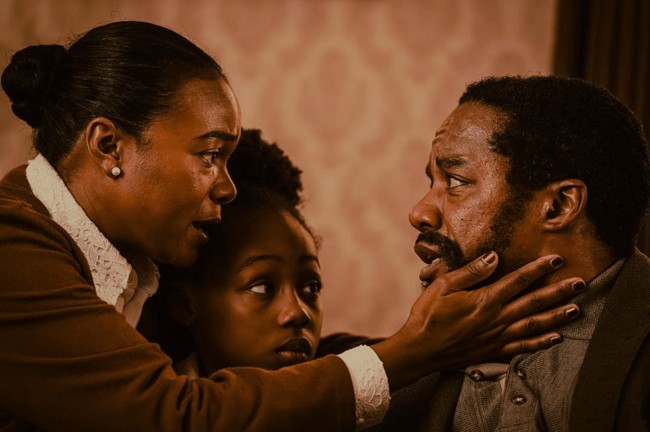
A major misfire from Shinya Tsukamoto (of “Testuo: The Iron Man” fame), “Mr. Nelson, Did You Kill People?” seeks to expose the horrors of the Vietnam War through the eyes of a Black American soldier. Based on the autobiographical writings of its subject, Allen Nelson, it has an unmistakable façade. This artificial texture works on rare occasion, but finds itself infecting the movie’s drama, which ends up awkward at best, and at worst, cacophonous and redundant.
It opens with Nelson as a young adult (played by Mark Merphy) sleeping in a ruin of trash and scavenging animals. This carefully-laid out excess screams Student Film 101, but if anyone has earned the benefit of doubt for their use of production design, it’s cyberpunk maestro Tsukamoto. However, this trust begins to fade once Nelson is approached by an old friend, now a grade school teacher, who invites him to speak to her class about her experiences in war. When he’s unable to adequately answer the innocent but loaded question of the movie’s title, the film skips forward several years to reveal its larger premise and flashback structure.


From the moment “Mr. Nelson” begins, the dialogue features a noticeable stiltedness and non-specificity, as though machine-translated from formal Japanese (there-is-not a single contraction to be found). It’s not just that Black New Yorkers wouldn’t talk this way; no one in the English-speaking world would either. This sets the stage for actors who feel disconnected from their own performances, which, during heightened emotional moments, yields the arduous melodrama of a school play. As a middle-aged adult, Nelson is played by a stone-faced Rodney Hicks, who happens to be a Broadway veteran, though you’d never know it.
At some point in the future, Nelson relays this grade school anecdote, alongside harrowing wartime stories, to his psychiatrist Dr. Daniels (Geoffrey Rush), who insistently asks him each time why he took lives in Vietnam. Rather than changing his stock answers about the nature of war, he loses his temper, only to come back the following week, relay another story — which we see plays out as vivid war drama — and end the session by repeating his emotional outburst, covered in a comical amount of sweat.
The movie’s cultural inquiries would also verge on offensive if they weren’t so devoid of lived reality. This realization creeps in as we see Nelson at home, interacting with his wife and step son, but it becomes more apparent during his wartime recollections. Set when the political place of Black America was especially unsteady, as men were called upon to fight for a country that wouldn’t give them equal rights, the movie’s cultural milieu is broached in dialogue several times, but is often left hanging in mid-air.
Alongside the question of why he pulled the trigger on so many occasions, Nelson’s response to this fraught dynamic is repetitive and verbose, but Tsukamoto isn’t really prepared to confront it in any meaningful way. At one point, Nelson gazes at a picture of Martin Luther King Jr., but the meaning Tsukamoto tries to gleam or create in this moment is a total headscratcher. His camera may get up close and personal, but this topic of Blackness feels entirely alien as presented on screen.
The film’s heightened reality creates, for better or worse, a warped perspective that makes each recollection feel like a carefully rehearsed stage play. Its portrayal of American wartime brutality is harsh and unforgiving, in a way that no Hollywood film is likely to be. If you notice a lack of fidelity to the uniforms, that’s a good thing, at least in a roundabout way. The U.S. military owns the copyright to its real attire and equipment, and tends to demand a say in the script in exchange for their use, so this element of the movie’s freeform fantasia at least serves a political purpose — whether intentionally or inadvertently. On one hand, that there exists a film about an American war from an outside perspective, which is so unflinching in its portrayal of war crimes, is a refreshing reversal of dominant cinematic narratives.
On the other hand, “Mr. Nelson” is a film of voluminous sensory input unmoored from real sensations. It’s loud, and brash, and seeks to imbue the frame with chaos and agony, but it all becomes indecipherable after a while. Where it should remind you of the eerie rhythms of “Full Metal Jacket,” its auditory assault is much closer to “The Goonies.” Rare are the moments it conjures any meaningful emotions, despite its macabre imagery.
The movie’s problems pile up the further it gets into its 2 hour running time (which feels endless, as it breezes past numerous natural exit points and potential crescendos). However, they’re all crystalized in one particular kind of shot, to which the movie keeps returning: Nelson seated on Daniels’ couch, who asks him, for the umpteenth time — take a shot for each one and you’ll drop dead — why he chose to kill people in ‘Nam.
Not only do these dramatic repetitions yield diminishing returns, Hicks also seems to run out of ways to answer with any kind of surprising modulation. When he finally does, there’s nothing profound or cathartic about it either. But more revealing than the content of these moments are their form: Hicks’s troubled performance ends up washed out by the invading sunlight, as though Tsukamoto (working as his own cinematographer) were completely unfamiliar with photographing Black skin.
Veering between occasional pop culture pastiches of Blackness (usually, in the form of violence) and a complete and total racial non-specificity, “Mr. Nelson, Did You Kill People?” ends up a lifeless simulacrum about death, and about how war turns ordinary people into killers, through the dehumanization of victims and perpetrators alike. It’s an admirable objective, but it’s undertaken at such a cultural distance, and with such incuriosity, as to be downright perplexing, far more often than it’s ever intriguing or instructive.
Grade: D+
“Mr. Nelson, Did You Kill People?” premiered at the 2026 Venice International Film Festival. It is currently seeking U.S. distribution.
What's Your Reaction?
 Like
0
Like
0
 Dislike
0
Dislike
0
 Love
0
Love
0
 Funny
0
Funny
0
 Wow
0
Wow
0
 Sad
0
Sad
0
 Angry
0
Angry
0










Comments (0)