

New Species of Giant Fungus Discovered in China Grows up to 20 Inches Tall
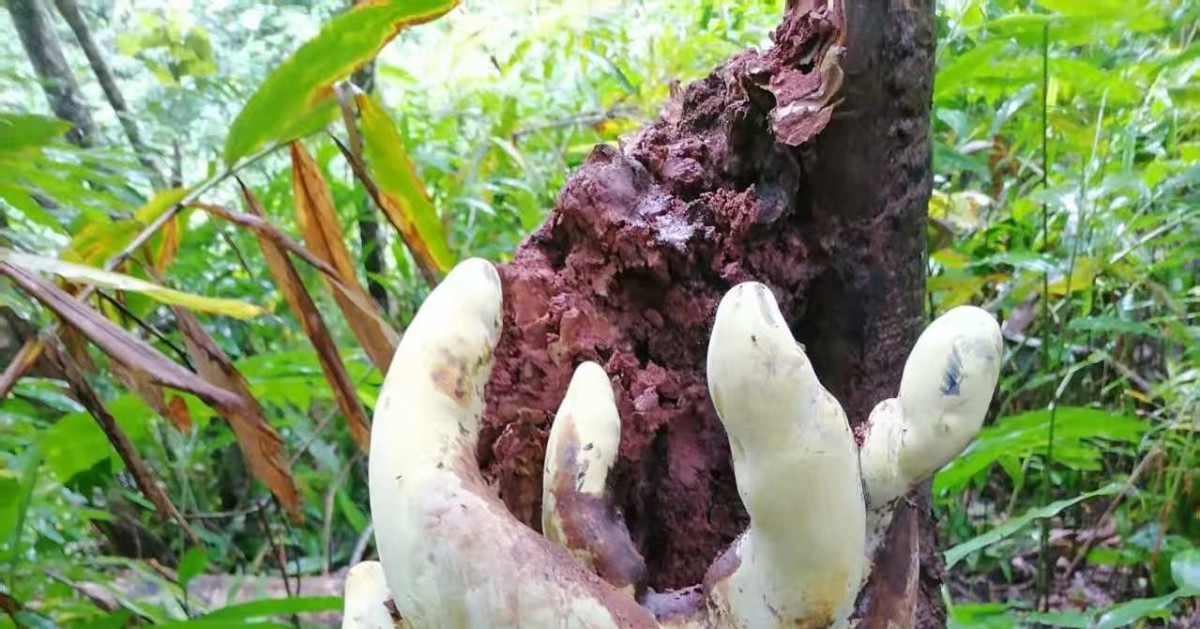
Sometimes new species evade detection because they’re tiny and thus easy to miss—not this giant fungus. Shaped like a hand reaching out of the ground, this new species of fungus was discovered deep in the forest in China’s Yunnan Province. A research team from the Kunming Institute of Botany, part of the Chinese Academy of Sciences, reported it as a new species they named Dianjunus rex.
The name comes from the region’s ancient Dian Kingdom and the Chinese pronunciation of the word “fungus.” D. rex is a type of Ascomycete, which is the largest phylum of fungi with over 64,000 known species, and among them, this new fungus produces the largest masses of mushroom recorded. Unlike what we typically think of as a “mushroom,” Ascomycetes don’t form caps and stems but produce structures called fruiting bodies, which release spores to reproduce. And growing up to 20 inches and weighting nearly five pounds, D. rex’s are huge.
Within the Ascomycetes, the giant fungus constitutes an entirely new biological family (the broader classification of genus and species), meaning that it has no close relatives—at least that we know of. While 6,000 fungal species have been documented in Yunnan, mycologists believe the province known for its biological diversity could easily harbor 100,000
“The discovery illustrates how much fungus biodiversity remains to be discovered in East Asian forests,” Indunil C. Senanayake, an associate professor at the Kunming Institute of Botany and the lead author of the paper, said in a press release.
Senanayake and his research team conducted surveys in the Nanban tropical rainforest, where they came across large, whitish fruiting bodies growing in the soil near the roots of dying trees. They documented and collected fungi growing in a wide variety of shapes like cylinders, spindles, and cupped palms. The fruiting bodies appeared to develop finger-like branches upon maturity. They found that the above-ground portions are covered with white, powdery fibers that turn dark yellow as the fungi mature while the portions buried in the soil are black and smooth.
What's Your Reaction?
 Like
0
 Dislike
0
 Love
0
 Funny
0
 Wow
0
 Sad
0
 Angry
0











Comments (0)