

Nvidia's Huang vows to deliver 'giant amounts' of Vera Rubin — company says that 'our roadmap is intact'

 (Image credit: Nvidia)
Jensen Huang, chief executive of Nvidia, denied reports about delays of the company's next-generation AI platform and said that production volumes of the upcoming Vera Rubin platforms are 'giant.' He didn't address reports about delays of Vera Rubin Ultra-based rack-scale systems carrying 144 AI GPUs.
"[The reports about Vera Rubin delays are] not true," Huang told reporters on the sidelines of an event in Japan, reports Bloomberg. "Vera Rubin is already in production. Giant amounts of production incoming."
Nvidia confirmed production of its Vera Rubin platform in January and then sampling in February, so the current comment reiterates what we already know. Nvidia stressing that 'giant amounts of production' are incoming is meant to reassure investors that the company is on track to sell a boatload of its next-generation Vera CPUs, Rubin GPUs, and Vera Rubin NVL72 systems in the coming quarters, which means more record-setting quarters.
What Huang did not address — or perhaps he wasn't asked — is Nvidia's rumored delay of its Kyber NVL144 rack-scale solution with copper interconnects due to the system's complex PCB midplane by more than a year from 2027 to 2028. An alternative dual-rack design has reportedly been canceled and an even larger CPO-based NVL576 configuration may also face delays or limited availability, the same report from SemiAnalysis claimed earlier this month. The setback could leave Nvidia's Rubin Ultra platform with a smaller NVLink scale-up domain than originally envisioned. Nvidia says its roadmap is intact.
The Kyber NVL144 architecture was designed to connect 144 Rubin Ultra GPUs using a copper-based NVLink 7 scale-up fabric, so the machine required a sophisticated PCB midplane to carry high-speed electrical links between the system's components. SemiAnalysis claims that this midplane was challenging to manufacture, leading to a delay. The report does not identify defective chips or problems with particular components mounted on the board, but specifically points to the manufacturability of the PCB infrastructure itself.
"Our roadmap is intact," a spokesperson for Nvidia told Tom's Hardware.
Nvidia's statement on the matter neither confirms nor denies the report, but indicates that the company will be able to offer products mentioned in its roadmap without revealing whether they also remain on their previously announced launch schedules.
Get Tom's Hardware's best news and in-depth reviews, straight to your inbox.
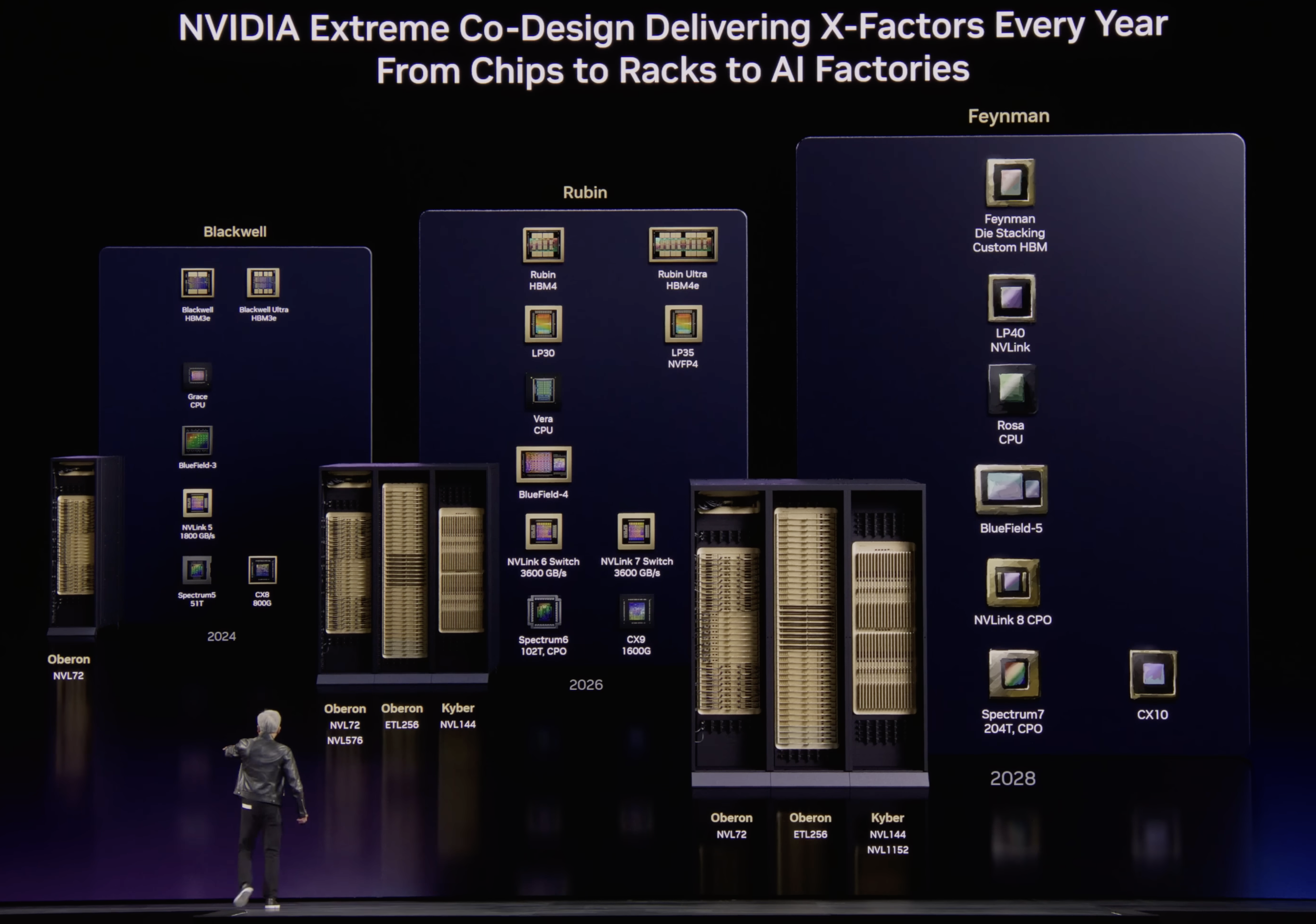
Nvidia reportedly considered another copper-based design, called NVL72x2, as an alternative to Kyber. The system would have placed two Oberon racks back-to-back to expand the size of the NVLink scale-up domain without using optical interconnects. However, SemiAnalysis says customers rejected the unusual design and operational requirements, but does not specify their individual objections that could include serviceability, cooling, cabling, and data-center layout.
Meanwhile, the planned NVL576 rack scale solution that was supposed to combine eight Oberon racks interconnected using co-packaged optics between NVSwitches has also been postponed, or shipped in relatively small quantities because of 'ongoing CPO challenges,' SemiAnalysis claims.
The existence of the planned NVL576 configuration suggests that Nvidia had been developing some form of CPO-enabled NVSwitch connectivity for the Rubin generation. In theory, similar optical switch-to-switch connectivity could potentially be used to join smaller GPU groups into an NVL144 system and bypass Kyber's problematic copper midplane. However, the available information does not clearly indicate whether the CPO technology intended for NVL576 could reproduce Kyber's topology, bandwidth, and latency characteristics, or whether it was sufficiently mature for high-volume deployments by potential NVL144 customers.
The reported Kyber delay comes on the heels of another report saying that Nvidia had canceled quad-compute-chiplet version of its Rubin Ultra in favor or a dual-compute-chiplet design that is projected to deliver 2X lower performance. With Kyber NVL144 delayed and NVL72x2 cancelled, Nvidia will only be able to offer 72-way scale-up systems till sometimes in 2028, meaning that AMD and Google may end up with more competitive scale-up systems in 2027 – 2028. AMD's Mega Pod based on the Verano CPUs and Instinct MI500-series accelerators, is expected to pack up to 256 accelerators. Google's TPU 8i can provide roughly 1,024–1,152 accelerators within one low-latency domain, whereas the TPU 8t goes much further and can get to 9,600 chip packages per domain.

Follow Tom's Hardware on Google News, or add us as a preferred source, to get our latest news, analysis, & reviews in your feeds.
Anton Shilov is a contributing writer at Tom’s Hardware. Over the past couple of decades, he has covered everything from CPUs and GPUs to supercomputers and from modern process technologies and latest fab tools to high-tech industry trends.
What's Your Reaction?
 Like
0
Like
0
 Dislike
0
Dislike
0
 Love
0
Love
0
 Funny
0
Funny
0
 Wow
0
Wow
0
 Sad
0
Sad
0
 Angry
0
Angry
0







Comments (0)