

Olivia Wilde’s ‘The Invite’ Masters Its (Very) Limited Space
[Editor’s note: The following interview contains some spoilers for “The Invite.”]
With the exception of the opening credit sequence, director Olivia Wilde’s “The Invite” takes place in a single location: Joe (Seth Rogen) and Angela’s (Wilde) San Francisco apartment, where they host their upstairs neighbors, Hawk (Edward Norton) and Piña (Penelope Cruz) for one hell of a dinner party.
The film is a masterful exercise in limited space. Production designer Jade Healy’s soundstage set, seen through cinematographer Adam Newport-Berra’s lens, becomes a constantly shifting landscape mirroring the rollercoaster ride of the awkward, sexy, and disastrously liberating evening in which the future of a marriage hangs in the balance.


IndieWire recently caught up with Wilde and Newport-Berra to discuss how they pulled it off.
The following interview has been edited and condensed for length and clarity.
The Rules: Frames Within Frames
Wilde: It began with the brain trust of Adam, Jade, and myself wrestling with the challenge of the limited space, and we came up with a certain set of rules: The idea that we would embrace frames within frames, that we would use the architecture to create barriers between characters who still had emotional barriers — we would use mirrors to allow characters to share space without seeing each other, we would use glass, we would use walls — and then slowly remove these barriers.
A few motifs that you see over and over again in the film, those were all part of a list of ideas that the three of us laid out at the beginning of production, and Jade built towards it when she designed the set.
 ‘The Invite’
Newport-Berra: How we told the story was through composition, and Jade Healy, our production designer, worked with us closely in proposing a set that had a lot of spaces and lines and shapes that intersected and conflicted with each other and angled off of each other so that I could find frames to build layers and depth.
Wilde: “Hannah and Her Sisters” is not a limited space film — you move in and out of those places — but all the apartments in that film really informed our apartment and the way we used the space. I always think about the cocktail party scene, where Carrie Fisher and Dianne Wiest are working as caterers, and they’re in the kitchen, and the kitchen door keeps swinging open and closed, and Sam Waterston is in there flirting with them. It is just one of the greatest scenes in any film, and it was a scene that doesn’t seem like it directly references the way we were creating the space, but it was a treasure trove of references that really informed doorways, hallways, and people overhearing each other.
 ‘Hannah and Her Sisters’©Orion Pictures Corp/Courtesy Everett Collection
Rooms and Withholding
Newport-Berra: I didn’t want it to feel confined; I wanted to feel liberated every day and feel excited exploring the space. That meant being decisive about how we showed the space and exposing it over time. There’s a version of the film where the second you enter the apartment, you see every space; you get a sense of the layout. But instead, we were withholding what we showed, so that each room took on new meaning; we allowed each room to be defined by different characters.
Each room represented a different part of their relationship. The bedroom was messy; it had cracked walls, and it hadn’t been painted yet. That signified everything that Joe and Angela had swept under the rug. Joe’s room [office] was equally messy and cluttered. That signified Joe’s inability to cope with his problems and his nostalgia and desire to hold on to the past, even though he didn’t want to accept it. Whereas the living room became Angela’s projection of what she wanted their life to be.
Landscape and Lenses
Newport-Berra: I wanted the film to feel big, dynamic, and ambitious. The first thing I pitched to Olivia was this idea of treating the film like a landscape. No matter if you’re shooting a massive Western out in the countryside or a thriller in a city, I’m trying to make the most out of whatever environment is given to me. It’s really about context and scale. How do we liberate ourselves within that space, and how do we make that space feel big? So it meant our close-ups were very close and our wides were very wide. I wanted to make the apartment feel as dynamic and expansive as I could, while honoring what was happening in the story.
Lensing was huge. I was really specific about the types of lenses I used on people versus wide shots. I was really selective about when I would use a wide lens, and I was really sparse with my use of wide lenses, and it was really only when we wanted to get scope within the scenes. Otherwise, we were working with medium and longer lenses, and sometimes we used the longer lenses to compress the space and feel more claustrophobic. We used medium lenses to feel more human, like we’re sitting there next to the characters.
 ‘The Invite’
We talked a lot about when to show characters together in a frame. If you notice, a lot of the film, there’s only one person in the frame at a time, and so we were really specific about when we included two shots, when we included four shots.
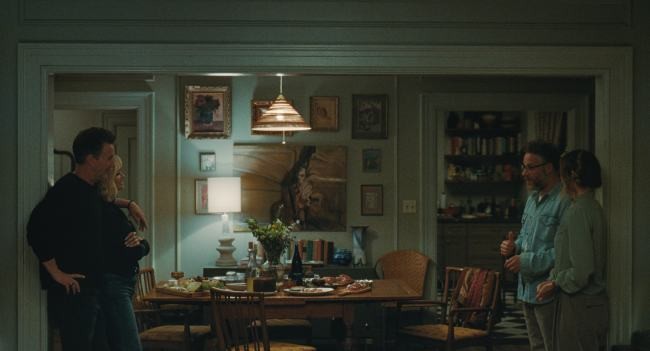
At the beginning of the movie, it’s single, single, single, single, or we’ll see just Hawk and Piña together, and Joe and Angela in separate close-ups. We worked really hard to establish that language so that by the time we’d get to that wide shot [pictured above] where we see all four of them in the frame, we’re like, “Oh, something could happen here.” Whereas before, we’re kind of seeing everyone on their own island and have their own version of reality, because everyone is coming at this from a completely different angle, and that’s what makes the movie so fun. So to then build to a point where we’re seeing them all in the frame, I think you’re, visually, albeit subconsciously, making this connection that, “Oh, maybe all four of these people can exist harmoniously in the same space.”
Precise, but Spontaneous
Wilde: During preproduction, Adam and I designed — I don’t know if we can call it shot listing, because we weren’t overly prescriptive about shot listing— but his approach to [shooting the film].
Editor’s note: While Wilde and Newport-Berra entered production with a plan of how to approach the shoot, asIndieWire reported earlier, Wilde embraced improvisation during a two-week workshopping phase that then extended into the 23-day shoot. Shooting chronologically allowed Wilde and the other actors to start each day of shooting by playing with the dialogue, story, and staging of that day’s scenes.
 ‘The Invite’
Newport-Berra: Each of the actors carried the physical history of the movie up until that point, so they could bring a lot to it. You just see things differently. You notice changes more, and I’m able to lean into those changes.
Wilde: I was not going to tell these actors exactly where to stand or how to be, but they’re all filmmakers [Rogen and Norton are established directors], so when I described the approach and the theory behind how we were going to use this space, they were very intrigued by the idea that we could use the architecture and the framing to allow the audience to feel at first unsettled, incredibly uncomfortable, and socially awkward, and then slowly unravel that to become very exposed.
 ‘The Invite’
They were on board with the theory and understood it well enough that I didn’t have to be overly prescriptive about where they should stand or how they should be. They understood the assignment and thought, “Oh, I get it. If we stand at four opposite corners, it will create an unsettling, awkward effect on the audience.”
Newport-Berra: We would do a read-through of the script every morning and talk about the scene, and the actors would naturally gravitate toward places. And then Olivia and I would be watching — or I would just be watching if Olivia’s in the scene — and we’d start to reorient: “What if you sat over there? What if you sat behind Olivia? What if you sat further away? What if you sat in that chair?”
All of a sudden, the dynamic starts to shift drastically just based on the fact that we thought we were so familiar with the space, but now it’s being seen from different angles. Those are the big landscape changes we were able to make in such a small space, and I think they resonated.
 ‘The Invite’
Editor’s note: To give an example of how this all worked, Newport-Berra pointed to the scene toward the end of the film, where Piña, a therapist, starts analyzing Joe and Angela’s marriage. It’s a scene set in the living room, which was the most-shot room in the film and had already been seen from a number of different angles.
Newport-Berra: That scene we talked about a lot. We wanted the space to feel different — fresh is not the right word because it wasn’t fresh — there was a lot of weight leading up to that.
No one had sat in that leather-strapped chair that Penelope was in up until that point in the film. Olivia had not sat in that couch until that point of the film, and we intentionally wanted Seth to be behind her, so that they couldn’t make direct eye contact unless Olivia decided to turn to him. There was space between Penelope and them for her to really look at them as a pair, and in that chair, it feels very therapist.
These all seem like insignificant, not big choices, but they’re huge choices, and these are decisive moments in the movie in terms of how the scenes were played.
“The Invite” is now in wide release from A24.
To hear Wilde’s full interview, make sure you subscribe to the Filmmaker Toolkit podcast on Apple, Spotify, or your favorite podcast platform.
What's Your Reaction?
 Like
0
Like
0
 Dislike
0
Dislike
0
 Love
0
Love
0
 Funny
0
Funny
0
 Wow
0
Wow
0
 Sad
0
Sad
0
 Angry
0
Angry
0










Comments (0)