

‘Reading Lolita in Tehran’ Review: A Beloved Literary Memoir About Rebellion Through Reading Gets a Straightforward Cinematic Treatment
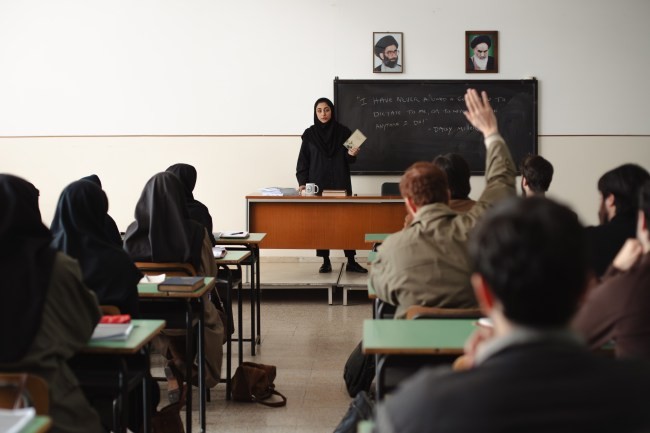
The fleeting impulse to label a film about women’s oppression in 20th-century Iran as a “feel-good movie” is enough to make you wonder if you’ve been irreversibly poisoned by the Eden’s apple of excessive media analysis. But even without being so reductive, there are more than a few moments within “Reading Lolita in Tehran” that feel like you’re watching an after-school special about the magic of reading.
That’s likely by design, but it robs the film of some nuance that would have made it more compelling. For all of its elegant musings about the power of literature and deeply emotive performances by an ensemble of actresses who clearly believe in the mission, Eran Riklis’ adaptation of Azar Nafisi’s bestselling memoir of the same name never manages to leave platitudes behind long enough to truly emulate the classic writing that inspired it. Instead, we’re left with a film about the universality of great novels that can’t quite figure out how to make a book about reading feel cinematic.


The real Nafisi is a beloved literary figure, a professor who has devoted the bulk of her life to evangelizing about the transcendence of Western literature in places where its liberal, humanist messages are much needed. Raised in Iran but educated in Europe and America, she briefly taught at the University of Tehran in the late 1970s before being forced out of academia for refusing to comply with the country’s strict theocratic rules. But even as she began spending more of her time in the West, she never lost sight of the women in her home country and their need for literary education.
Riklis’ film splits its attention between two timelines, following Nafisi (played by Golshifteh Farahani) as both a young professor enduring harassment from male colleagues and students who declare “The Great Gatsby” to be profoundly immoral, and as a mid-1990s academic exile who invites female students to discuss banned books in her apartment. This group provides the title of both Nafisi’s memoir and the film, as she encourages her students to use transgressive literature to understand their own place in the world.
They come to understand that “Lolita” has less to do with pedophilia than Vladimir Nabokov’s exploration of a man’s ability to rationalize his darkest desires. Some women begin to see themselves in the eponymous sexualized child, relating to the way that men in their lives see them as a blank canvas rather than a fully formed human being. Ditto for Jane Austen, whose “Pride and Prejudice” illustrates how every society has had its own convoluted courtship rituals and built women’s roles around them.
The film uses a simple visual language to convey the sense of freedom these women find in reading: The book club scenes are brightly lit and filled with color, whereas the rest of Nafisi’s life in Tehran is shot in muddy, grayish hues. And Farahani gives an excellent performance as Nafisi, using her eyes to convey the constant pain of a woman whose mind has so much more to offer a society that’s always telling her to do less. It’s all in service of the film’s central point that reading can be a window to the outside world no matter how dark your life might seem.
It’s all correct, of course. This critic certainly believes that there’s a universal brilliance to Austen’s social satire, Nabokov’s slippery use of perspective, and F. Scott Fitzgerald’s piercing understanding of the American soul. And if you’re reading this and sincerely considering an outing to see a film called “Reading Lolita in Tehran,” it’s a safe bet you do, too. That’s the meta problem that a film like this has to reckon with: When your audience has likely already bought into your core message before they make it out of the concession line, you have to eventually offer them something richer. For all of its noble intentions, “Reading Lolita in Tehran” never quite gets there. All the references to the world’s greatest literature, with their endless layers of narrative depth, ultimately feel like a reminder of how little is on display here by comparison.
Still, “Reading Lolita in Tehran” should please fans of Nafisi’s book — and there are worse ways to spend less than two hours if you’re a bibliophile who needs a reminder about the enduring power of literature. It’s hard to disagree with any of the film’s lovely messages; it’s just equally hard to recommend it to anyone who wasn’t already a diehard fan of the material.
Grade: C+
A Greenwich Entertainment release, “Reading Lolita in Tehran” is now playing in select theaters.
Want to stay up to date on IndieWire’s film reviews and critical thoughts? Subscribe here to our newsletter In Review by David Ehrlich, in which our Chief Film Critic and Head Reviews Editor rounds up the best new reviews and streaming picks along with some exclusive musings — all only available to subscribers.
What's Your Reaction?
 Like
0
Like
0
 Dislike
0
Dislike
0
 Love
0
Love
0
 Funny
0
Funny
0
 Wow
0
Wow
0
 Sad
0
Sad
0
 Angry
0
Angry
0











Comments (0)