

Sigma's New 20-60mm Zoom Takes Aim at the Kit Lens
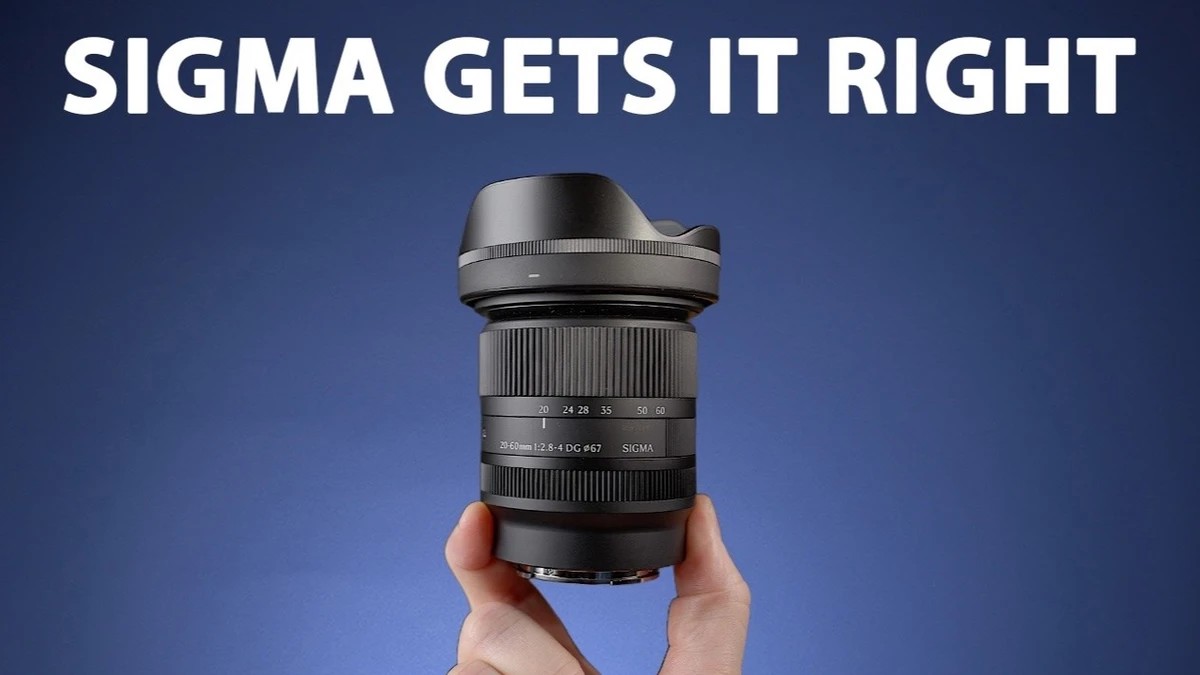
Most full frame cameras ship with a slow, middle-of-the-road zoom that people outgrow within months, and the Sigma 20-60mm f/2.8-4 DG Contemporary takes direct aim at that weak spot. The lens on your camera on day one decides how much you enjoy the thing you just spent a lot of money on, and a better starting zoom can push back the moment you feel you need more glass.
Mark Bennett makes the case that the Sigma 20-60mm f/2.8-4 DG Contemporary is what camera makers should be bundling, and the comparison is easy to follow. Typical kit zooms run 24-70mm or 24-60mm and often open at f/3.5 or even f/4.5. This one starts at 20mm and f/2.8, then still holds f/4 at the long end. The body is mostly hard plastic and rubber with some metal parts, and the barrel extends as you zoom, which keeps it short when you carry it. At 372 g without caps, it sits comfortably on a Sony a7R V, and you get a 67mm filter thread, dust and moisture resistance, and a petal hood. There's no optical stabilization and there are no buttons or switches, so you're relying on your camera's in-body stabilization.
Variable aperture zooms have a reputation for soft corners, and this one holds up better than you might expect. At 20mm and f/2.8, the corners are a step behind the center but still more than usable. Zoom to 60mm at f/4 and you get much the same result. For edge-to-edge sharpness, Bennett suggests stopping down to around f/5.6. Autofocus is close to instant at both ends of the range, with no visible hunting, though Sony bodies cap third-party lenses at 15 fps in continuous autofocus. Focus breathing is barely visible at 60mm and only slight at 20mm, which helps because Sony's breathing compensation doesn't work with third-party glass.
Zooms that start at 20mm have quietly become a category of their own over the last few years. Sony's FE 20-70mm f/4 G and Tamron's 20-40mm f/2.8 Di III VXD both reflect the same shift: more people shoot stills and video from one body, and video eats into your field of view. Electronic stabilization crops the frame, and many cameras crop further in certain 4K frame rates, so a 24mm lens can end up looking closer to 28mm or 30mm on screen. Starting at 20mm gives you margin to absorb that crop and still frame a room or hold yourself at arm's length. Phones have also trained a lot of people to expect a wider default view, since main phone cameras sit around a 24mm-equivalent and ultra-wides are one tap away. Compare that to bundled lenses like the Sony FE 28-60mm f/4-5.6 or the Canon RF 24-50mm f/4.5-6.3 IS STM, and the gap is easy to see. If you shoot travel, interiors, or any video where you're both in front of and behind the camera, a wide start does more work day to day than an extra 10mm at the long end.
The small size costs something in uncorrected raw files. At 20mm, you get strong barrel distortion and heavy vignetting at f/2.8. Both flatten out around 35mm, then pincushion distortion and some vignetting appear at 60mm. Sigma already has a Lightroom profile that fixes this in one click, and the camera handles corrections automatically for JPEGs and video, so leaving in-camera corrections on is the simple route. At $849, the lens also lands near Sigma's own 28-70mm f/2.8 DG DN Contemporary, which gives you a constant f/2.8 in exchange for a noticeably tighter wide end and a bigger body.
Bennett's sunstar samples at 20mm and 60mm are in the video above.
What's Your Reaction?
 Like
0
 Dislike
0
 Love
0
 Funny
0
 Wow
0
 Sad
0
 Angry
0










Comments (0)