

Solana Inflation Cut Wins 67 Percent Vote to Slow Future Issuance
TLDR:
- The Solana inflation cut passed with 67% support, only 0.33 percentage points above the required two-thirds supermajority.
- SGP-0002 doubles annual disinflation from 15% to 30%, cutting projected SOL issuance by 18.9 million tokens over six years.
- The approved direction keeps the 1.5% terminal inflation floor, while shortening the estimated path from 5.7 years to 2.8 years.
- SGP-0003 failed with 53.9% support, leaving the existing transaction-fee structure and an estimated 648 SOL daily burn unchanged.
Solana validators approved the Solana inflation cut with 67% support, narrowly clearing the network’s 66.67% supermajority requirement. The vote advances SGP-0002, which doubles the annual disinflation rate from 15% to 30%. Its authors estimate projected SOL issuance will fall by 18.9 million tokens during the next six years.
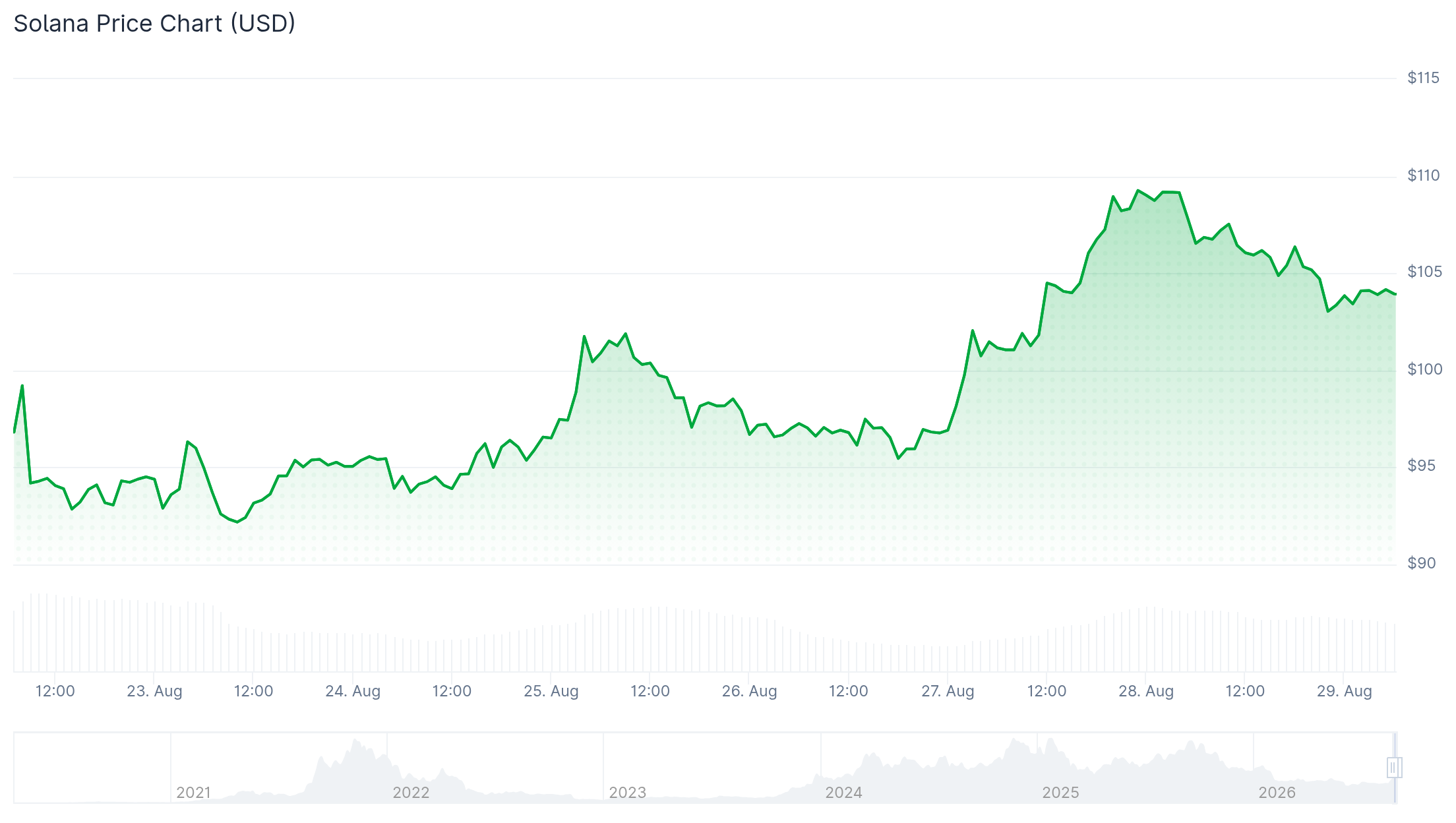
Voting participation reached 60.7% of eligible stake, exceeding the required one-third quorum. SOL traded near $104 after the result, down roughly 3.3% over 24 hours, according to Coingecko data. The approved direction does not change rewards immediately. Developers must finish the consensus code and schedule feature activation before the faster path begins.
Solana (SOL) PriceSolana Inflation Cut Speeds the Path to the 1.5% Floor
The tally recorded 176.29 million SOL for SGP-0002 and 66.19 million against it. Abstentions totaled 20.63 million SOL, bringing votes cast to 263.11 million SOL. Abstentions counted toward the denominator, leaving the proposal 0.33 percentage points above passage.
Kraken helped decide the result. Its validator shifted voting stake against the plan, pushing support near 65%. It later moved more than 90% of 8.9 million SOL to yes before voting closed.
The Solana inflation cut does not halve the current inflation rate. Instead, it doubles the disinflation rate governing annual reductions. Solana keeps its 1.5% terminal floor under the approved path.
Under SIMD-0550, the network would reach that floor in about 2.8 years. The current schedule needs 5.7 years. Projected SOL issuance falls by about 2.6% across six years, equivalent to the estimated 18.9 million tokens.
The supply effect could reduce dilution for holders. However, validators and delegators would see staking rewards decline faster.
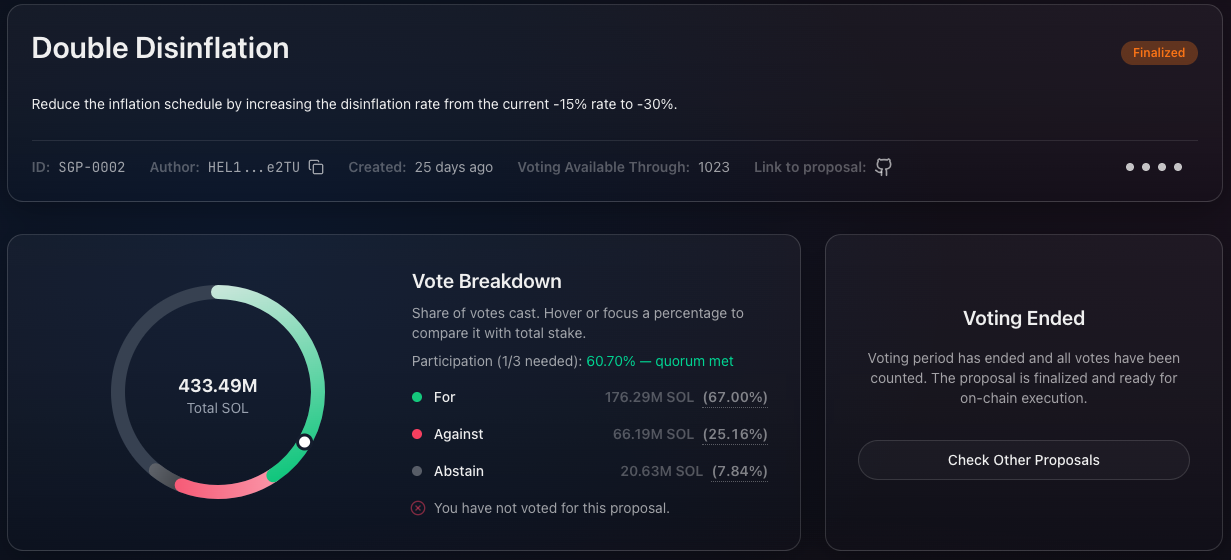 Solana’s validator governance dashboard,
The Solana inflation cut needs implementation work. The technical document stayed under review after the vote and listed no activation schedule. Validator clients must add the double-disinflation-rate feature gate before mainnet activation.
Developers designed the transition to preserve continuity. At activation, software will anchor the existing inflation rate and apply the steeper curve afterward. Completed epoch rewards will not change retroactively.
The change affects consensus since inflation rewards enter bank capitalization and bank hashes. Every validator client must compute identical reward values to avoid conflicting network states.
Validator Economics Split as Solana Fee Reform Falls Short
Stakeholders split over the revenue trade-off. Figment voted its 17.1 million SOL against SGP-0002, while Helius and Jupiter supported it. Everstake and P2P Validator also opposed the Solana inflation cut.
Faster disinflation can reduce custodial operators’ staking-fee income. Helius CEO Mert Mumtaz disputed arguments that yield preservation should outweigh lower SOL issuance. Solana Company also voted no, citing stable assumptions for institutional forecasts.
Solana Validator Governance has concluded.
Results:
 SGP-0001: The Solana Constitution SGP-0002: Double Disinflation
 SGP-0003: Resource and Inclusion Fee
— Solana (@solana) August 28, 2026
Meanwhile, SGP-0003 failed with 53.9% support despite 61.14% participation. The plan would have replaced the 5,000-lamport base fee with a 2,500-lamport inclusion fee and a resource charge.
Validators would receive inclusion and priority fees, while the protocol would burn the resource portion. Modeling projected 7,500 to 9,000 SOL in daily burns.
Current fee rules burn roughly 648 SOL daily. The proposal’s final stage would have burned 0.5% of supply annually. That level would still trail SOL inflation near 3.8%.
Transaction costs would have varied with requested resources. One modeled validator vote cost 12.3% less, while a zero-priority Pump.fun swap cost 3,150% more. Applications reserving excess compute would have paid for their full request, not actual usage.
The failed fee vote keeps the fee structure and burn rate in place. Unlike SGP-0002, supporters can resubmit SGP-0003 without a cooling-off period.
July transactions reached 4.2 billion, while 1.32 billion non-vote transactions occurred during August 17 through August 23. The Solana inflation cut could therefore arrive amid record use and debate over the network’s security budget.
The post Solana Inflation Cut Wins 67 Percent Vote to Slow Future Issuance appeared first on Blockonomi.
What's Your Reaction?
 Like
0
Like
0
 Dislike
0
Dislike
0
 Love
0
Love
0
 Funny
0
Funny
0
 Wow
0
Wow
0
 Sad
0
Sad
0
 Angry
0
Angry
0









Comments (0)