

The Most Detailed Photos Ever of the Sun’s Surface
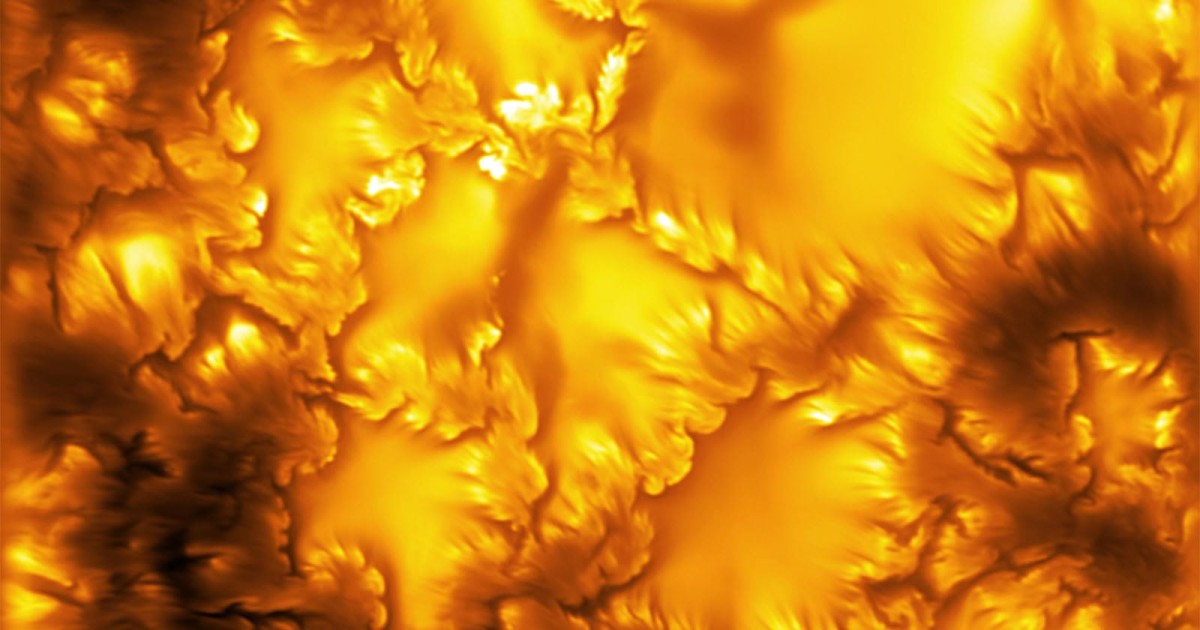
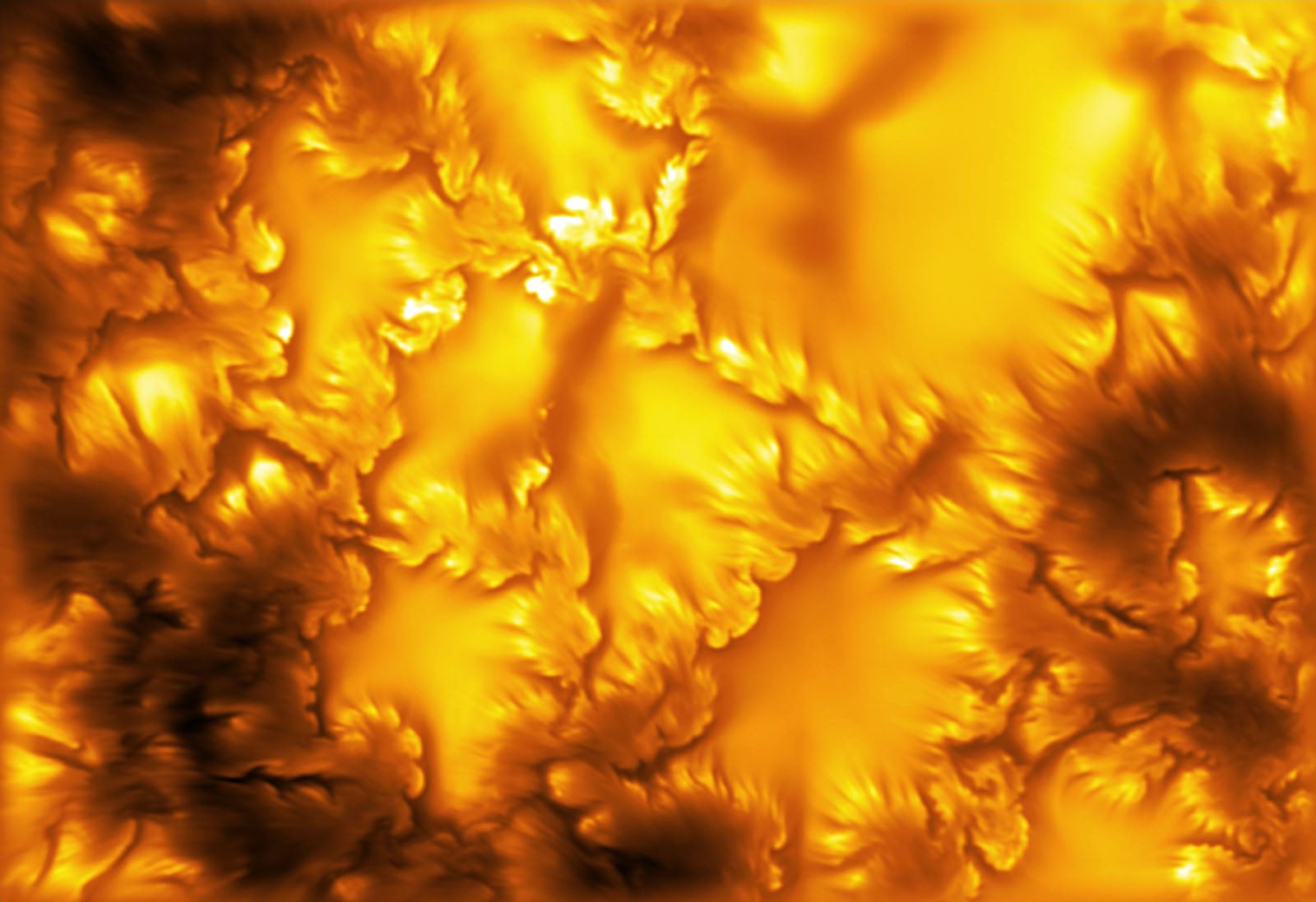 ‘The highest-resolution image of the Sun’s surface (photosphere) ever captured, taken at 416 nm by the Inouye Solar Telescope. It reveals deformed boundaries of magnetic elements and ultra-fine scale stripes, both associated with Kelvin-Helmholtz instability.’ | Credit: NSF/NSO/AURA/MPS
Scientists have captured the most detailed photos of the Sun’s surface yet, revealing mysterious solar processes with incredible resolution.
A team of international researchers from the U.S. National Science Foundation National Solar Observatory (NSF NSO), the NSF NCAR High Altitude Observatory (HAO), and the German Max Planck Institut für Sonnensystemforschung (MPS) used the world’s largest solar telescope, the NSF Daniel K. Inouye Solar Telescope, to discover Kelvin-Helmholtz Instability (KHI) on the surface of the Sun.
“An effect caused by fluid motion, KHI occurs when two fluids slide past each other at different velocities creating a ‘shear’ at the interface — causing small disturbances to grow into striking, wave-like or spiraling, vortices that look like breaking ocean waves,” the National Solar Observatory explains.
 The U.S. National Science Foundation’s Daniel K. Inouye Solar Telescope in Maui, Hawaii | Credit: NSF/NSO/AURA
KHI, formulated by Lord Kelvin and Hermann von Helmholtz around 1870, has been observed in many areas of physics, including fluid dynamics, oceanography, astrophysics, and heliophysics. However, it has been photographed on the Sun with this level of precision before.
The new high-resolution photos and timelapse videos captured by the Inouye Solar Telescope reveal “deformed boundaries of magnetic elements and ultra-fine scale stripes,” which are both heavily associated with Kelvin-Helmholtz Instability.
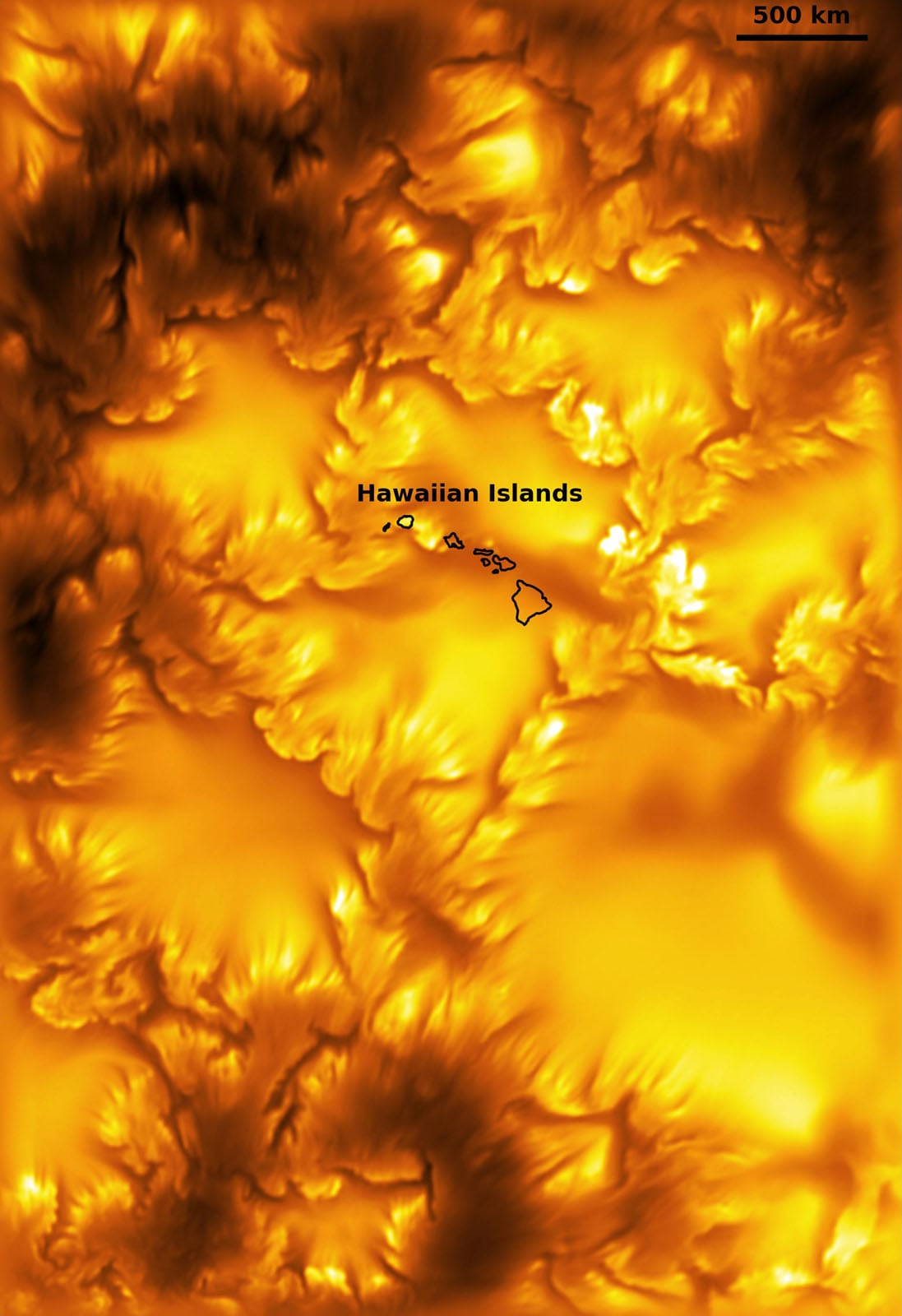
Scientists are particularly interested in the “swirling vortices of magnetic solar plasma” on the Sun because they may be an important driving force for solar activity, which affects space weather and can disrupt communications technologies on Earth.
A leading theory is that the Sun builds up magnetic energy through a process called “flux braiding,” in which magnetic field lines twist around each other, like a braid in hair. What’s not clear yet is what causes this to happen in the first place, and scientists think that the swirling patterns from KHI may be part of the answer.
“Since the swirls seem to be happening constantly and everywhere on the Sun’s surface where there is a strong enough magnetic field, they could be the everyday ‘engine’ that keeps twisting the magnetic field lines and setting the whole process in motion,” NSO says.
“We are only at the beginning of recognizing the wide-reaching impact the discovery of Kelvin-Helmholtz instability has on our understanding of the connection between the magnetized plasma motion and the energy transport and release into the upper solar atmosphere,” explains Dr. Friedrich Wöger, Senior Scientist at the National Solar Observatory.
“It is very exciting to see that the highest-resolution observations of the solar photosphere revealed a new dynamical regime in the form of KH vortices at the edges of magnetic field concentrations. These observations also provide the highest resolution validation of solar magnetohydrodynamic simulations to date, and the agreement in physical details is impressive,” adds Dr. Matthias Rempel, Senior Scientist at the High Altitude Observatory.
The team of researchers has just published its research, “Ubiquitous Kelvin–Helmholtz instabilities driving plasma mixing on the Sun,” in Nature. The science is obviously incredible, but the photos are remarkably beautiful, too.
Image creditsNSF/NSO/AURA/MPS
Affiliate Disclosure PetaPixel articles may include affiliate links; we may earn a commission if you buy through one.
What's Your Reaction?
 Like
0
Like
0
 Dislike
0
Dislike
0
 Love
0
Love
0
 Funny
0
Funny
0
 Wow
0
Wow
0
 Sad
0
Sad
0
 Angry
0
Angry
0











Comments (0)