

The Sony FX5 Is the FX3 With the Two Features Everyone Asked For
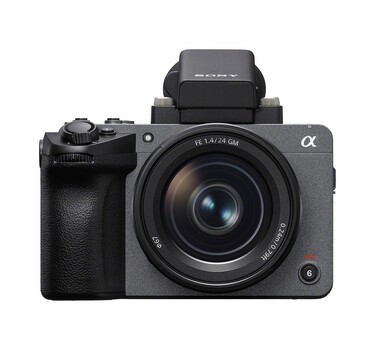
Sony has announced the FX5, a full frame Cinema Line camera built around a newly developed image sensor, with Open Gate shooting and internal raw recording that mark firsts for the FX series.
The Sony FX5 uses a full frame, fully stacked Exmor RS CMOS sensor paired with the BIONZ XR2 image processing engine and a dedicated AI processing unit. Sony rates the sensor at 15+ stops of dynamic range in S-Log3 and gives it three base ISO settings of 800, 4,000, and 12,800. Manual base ISO selection works only in Cine EI and Flexible ISO modes; in Cine EI Quick mode the camera picks the optimal base ISO according to the Exposure Index setting.
A Dual Gain Shooting function, new to the FX series, pulls additional information from the sensor for smoother gradation and wider latitude while reducing noise and preserving shadow detail. Gain in this mode is limited to the equivalent of 18 dB, and the function may not be available depending on shooting settings.
Open Gate and Internal X-OCN
The FX5 is the first FX-series camera to support 3:2 full-pixel readout across the entire sensor, or Open Gate shooting, in addition to 17:9, 16:9, and Super 35mm scan modes. It also records internally in X-OCN, Sony's 16-bit scene-linear raw format, without an external recorder. Alongside the existing X-OCN LT, Sony has added two new codecs, X-OCN C1 and X-OCN C2, which reduce data size to speed transfers and simplify post-production.
Frame rates at launch reach 5K at up to 60 fps, 4K at up to 120 fps, and FHD at up to 240 fps.
Autofocus, White Balance, and Image Controls
AI-based human pose estimation recognizes a subject's eyes, head, and body, which Sony says maintains autofocus performance in dark scenes. Real-time Tracking follows subjects automatically.
Auto Tracing White Balance combines visible-light and infrared sensor data with deep-learning light-source estimation. Sony says this produces more stable and natural white balance in shade, indoors, and similar conditions, though the improved stability applies only when recording in X-OCN.
Noise suppression can be switched on or off to match shooting intent and post-production workflow. A de-squeeze function supports anamorphic lenses at 1.3x, 1.5x, 1.6x, 1.8x, and 2.0x.
Body, Stabilization, and Monitoring
The camera carries 5-axis optical in-body image stabilization. Sony states that the latest stabilization unit roughly doubles the roll correction range of the previous system, based on internal measurements compared to the Sony FX3. Active Mode and a new Dynamic Active Mode handle handheld footage. In Dynamic Active Mode, the frame is cropped more than in Active Mode and Clear Image Zoom is unavailable. Dynamic Active Mode works up to 60 fps with a maximum gain of 26 dB, while Active Mode works up to 120 fps. Depending on codec and frame rate settings, Dynamic Active Mode may not be available at all.
The 3.5-type touch-panel LCD carries approximately 2.76 million dots in a 16:9 ratio and is larger than the FX3's. It mounts on a 4-axis multi-angle arm, tilting roughly 98 degrees up, 40 degrees down, and opening approximately 180 degrees to the side, with an adjustable high-brightness panel. Shooting information sits around the edges of the screen so it does not overlap the image. The BIG6 home screen, carried over from CineAlta cameras, collects frame rate, exposure, LUTs, and other key settings. A new menu system brings operability in line with CineAlta cameras and the Sony FX6 on shared productions.
Power, Connectivity, and Reliability
A high-efficiency cooling fan and optimized heat dissipation are intended to keep the camera stable through long recording sessions. The body is lightweight and rigid, with screw holes in multiple locations for attaching accessories directly, so rigs can be built without a cage.
The camera uses the recently released Sony NP-SA100 high-capacity battery at 2,670 mAh, which holds approximately 1.3 times the capacity of the Z-series Sony NP-FZ100. Two USB Type-C ports accept timecode input through an optional adapter cable and external power through USB Power Delivery; a PD-compatible external power supply and USB cable are not included. A wired LAN terminal handles remote operation and network connections. Integration with the Monitor & Control application brings video monitoring and remote operation to smartphones, tablets, and Mac.
Accessibility features include a screen reader that reads menus aloud and an enlarged menu display. Supported languages vary by region, and some menu items are not covered by the screen reader.
Recycled plastic accounts for approximately 30% or more of the camera body's parts, according to Sony research. The Thailand and China sites building the camera run on 100% renewable energy, though production sites may change depending on the production period. Product bags use plant-derived nonwoven fabric.
Firmware Update Version 2.0
A planned update, coming in 2027, will add high frame rate shooting up to 240 fps in X-OCN, XAVC S-I recording in 3:2 Open Gate, an optimized interface for vertical shooting, and a frame grab function. Sony notes that features and specifications are subject to change without notice.
Optional Accessories
The Sony DVF-EL1 is a detachable 0.58-type OLED viewfinder with approximately 7.07 million dots. It supports HDR display with a DCI-P3-equivalent color gamut and 10-bit gradation. Magnification is approximately 0.9x with a 50mm lens at infinity, -1 m⁻¹, and users can switch between display modes that prioritize resolution or eye point. A tilt mechanism moves from 0 to approximately 90 degrees upward. The viewfinder cannot be used together with accessories attached via the Multi Interface Shoe, including the handle unit.
The Sony XLR-H2 handle unit carries two XLR/TRS combo terminals and supports up to 4-channel audio input. Dual AD converters digitize microphone signals across a wide dynamic range and record in-camera at up to 96 kHz, 32-bit float. It connects directly to the body through the Multi Interface Shoe for digital transmission.
The Sony VMC-BNCU1 is an optional USB-C to BNC timecode adapter cable that feeds timecode from external devices into the camera, synchronizing multiple cameras and external audio devices for multicamera, broadcast, and filmmaking workflows.
Supporting Software
Monitor & Control version 3.0 is scheduled for July 2026 or later and enables wired and wireless video monitoring and camera control. Catalyst Prepare version 3.0 is scheduled for August 2026 or later; Catalyst Prepare and Catalyst Browse, which provide video stabilization and color editing, merge into the single version 3.0 release.
Key Specs
- Full frame, fully stacked Exmor RS CMOS sensor
- BIONZ XR2 image processing engine with dedicated AI processing unit
- 15+ stops of dynamic range in S-Log3
- Three base ISOs: 800, 4,000, and 12,800
- Dual Gain Shooting mode, gain limited to 18 dB equivalent
- Scan modes: 3:2 Open Gate full-pixel readout, 17:9, 16:9, Super 35mm
- Internal 16-bit scene-linear X-OCN raw recording
- Codecs: X-OCN LT, X-OCN C1, X-OCN C2
- 5K up to 60 fps, 4K up to 120 fps, FHD up to 240 fps
- AI-based human pose estimation with eye, head, and body recognition
- Real-time Tracking
- Auto Tracing White Balance using visible-light and IR sensor data with deep-learning light-source estimation
- Selectable noise suppression (on/off)
- Anamorphic de-squeeze at 1.3x, 1.5x, 1.6x, 1.8x, and 2.0x
- 5-axis in-body image stabilization with roughly double the roll correction range of the FX3
- Active Mode (up to 120 fps) and Dynamic Active Mode (up to 60 fps, 26 dB maximum gain)
- 3.5-type 16:9 touch-panel LCD, approximately 2.76 million dots, 4-axis multi-angle arm
- LCD articulation: approximately 98 degrees up, 40 degrees down, approximately 180 degrees to the side
- BIG6 home screen carried over from CineAlta
- CineAlta- and FX6-consistent menu system
- High-efficiency cooling fan with optimized heat dissipation
- Multiple body screw holes for direct accessory mounting
- NP-SA100 battery, 2,670 mAh, approximately 1.3x the capacity of NP-FZ100
- Two USB Type-C ports with timecode input support and USB Power Delivery
- Wired LAN terminal
- Monitor & Control app integration for iOS, Android, and Mac
- Screen reader and enlarged menu display accessibility options
- Approximately 30% or more recycled plastic in body parts
- Planned 2027 firmware: 240 fps X-OCN, XAVC S-I in 3:2 Open Gate, vertical shooting interface, frame grab
Price and Availability
The ILME-FX5 with XLR Handle Unit ships in mid-August at a suggested retail price of $5,499.99 USD / $6,999.99 CAD. The ILME-FX5B body ships in mid-August at $4,899.99 USD / $6,299.99 CAD.
What Sony and Its Collaborators Say
Yang Cheng, Vice President of Imaging Solutions at Sony Electronics Inc., framed the camera as an extension of the FX3: "We wanted to build on the FX3, taking it one step further with the inclusion of some VENICE 2 features, like internal RAW recording and Open Gate. Features like these have been highly requested and will allow creators more creative freedom with an easier workflow."
Cinematographer Claudio Miranda, ASC, whose credits include "Top Gun: Maverick" and "F1 The Movie," conducted a test shoot with the camera: "I felt that FX5 is a camera that combines high quality image expression and mobility in a compact body, enabling people to use it across a wide range of shooting environments."
Director Gareth Edwards, of "The Creator," "Rogue One: A Star Wars Story," and "Jurassic World: Rebirth," shot with the FX5 on a project spanning Cambodia, Thailand, and Nepal. "Guerrilla filmmaking just went to the next level as the FX5 is the run-and-gun cinema camera to beat," he said. The project is on YouTube.
Why This Matters for Video Creators
The two headline additions, Open Gate and internal X-OCN, address specific production problems rather than serving as spec-sheet padding.
Open Gate matters most to anyone delivering to more than one aspect ratio. Shooting the full 3:2 sensor area means a single take can be reframed for 16:9 broadcast, 17:9 theatrical, 9:16 vertical, and square social crops in post without reshooting or accepting a soft upscale from a cropped region. For commercial and branded work, where clients routinely expect deliverables across several platforms, that consolidates what has often been separate camera setups or separate shooting days. It also gives more room for stabilization and reframing in post, since the extra sensor area functions as headroom.
Internal raw removes a physical link from the rig. Recording X-OCN to cards rather than an external recorder means fewer cables, less power draw, less weight, and one less failure point on a handheld or gimbal build. For documentary and run-and-gun work, where setup time and rig mass directly limit what gets captured, this is a meaningful practical change. The new C1 and C2 codecs address the corresponding drawback: raw files are large, and reduced data sizes mean shorter transfers, less storage, and faster turnaround.
The three base ISOs and Dual Gain Shooting expand the range of lighting conditions the camera handles without added noise, which matters for work in mixed or uncontrolled light. Menu and interface consistency with CineAlta and the FX6 has a less obvious but real value on multicamera productions, where operators moving between bodies lose time to divergent menu structures. The 32-bit float audio recording through the XLR-H2 similarly reduces the risk of unrecoverable clipped or under-recorded audio, which matters most when there is no dedicated sound operator on set.
For photographers expanding into video work, the FX5 sits at a price point well above hybrid mirrorless bodies but below dedicated cinema cameras, and it brings features previously reserved for VENICE 2 into a body that can be operated by one person.
Conclusion
The FX5 narrows the gap between Sony's compact FX bodies and its high-end cinema cameras. Open Gate capture and internal X-OCN were the two features that most clearly separated the FX3 and FX6 from VENICE, and both now appear in a body that can be rigged light and carried alone. The launch frame rates are conservative relative to what the 2027 firmware promises, and the delay of 240 fps X-OCN and 3:2 XAVC S-I to next year means early buyers pay full price for a camera whose full capability arrives later. Whether the price positions it competitively depends on how the market responds, but as a package for creators who need cinema-grade capture without a cinema-grade crew, the FX5 is a substantial step forward from the FX3.
What's Your Reaction?
 Like
0
Like
0
 Dislike
0
Dislike
0
 Love
0
Love
0
 Funny
0
Funny
0
 Wow
0
Wow
0
 Sad
0
Sad
0
 Angry
0
Angry
0










Comments (0)