

What the X100VI Does Better Than the X-E5 (and What It Doesn't)
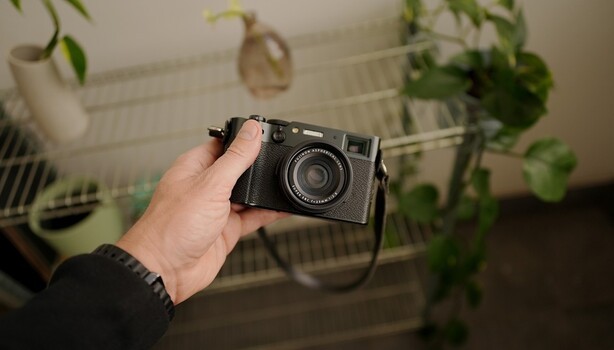
The Fujifilm X100VI carries a fixed 23mm lens, a leaf shutter, and a 40-megapixel sensor in a body small enough to live in your hand all day. Deciding whether that fixed-lens design suits how you shoot comes down to a single tradeoff most buyers wrestle with.
After borrowing a friend's copy and living with it on a trip, Mitch Lally walks through what two days with the Fujifilm X100VI taught him, measured against the Fujifilm X-E5 he's shot with for over a year. The built-in lens turns out to be a genuine strength, giving you a 35mm equivalent view at f/2 in a package that stays compact. That leaf shutter matters when you reach for the in-camera flash, since it drops the maximum sync-speed ceiling most cameras impose. Wide open at f/2, the files carry a look Lally clearly likes, with the option to stop down for deep focus or open up to separate a subject from the background.
Lally edits his raw files individually rather than leaning on Fuji's film simulations, building a signature look he's refined for years. He does note the files hold up straight out of camera, and calls out Astia as his favorite simulation for its skin tones, while classic chrome runs a little pink for his taste. Both cameras share most of the same internals, so the rendering feels close between them. The special quality, he argues, comes down to that 23mm lens rather than the sensor. He also found the X100VI is built better than his X-E5, even though the X-E5 is no cheap body itself.
The deciding factor for Lally is the interchangeable mount on the X-E5. He pairs it with an inexpensive Viltrox 25mm f/1.7 he loves, and can swap in a Sigma 17-40mm f/1.8 when a portfolio shoot calls for more reach. Both cameras hit 40 megapixels, so cropping in gives plenty of room, but the zoom lets him crop on top of that reach. A compact prime or the Fujifilm 27mm f/2.8 pancake gets his X-E5 close to the same travel-ready weight anyway. He never quite tips his hand on how the low-light comparison against the Ricoh GR shakes out, so watch for that.
The choice here maps onto a wider split among people buying compact cameras right now. A fixed lens forces one focal length, and that constraint is exactly what draws many shooters to the X100 series and the Ricoh GR line. You stop deliberating over which lens to bring and start paying attention to framing, distance, and timing instead. That discipline is why street and documentary shooters have kept the 35mm-equivalent field of view in rotation for decades. If you already own a full-frame body for paid work, a single-lens camera fills the "always with you" slot without duplicating your kit. If you're building your only system, the mount and its glass decide how far the camera can grow with you. Lally lands on the X-E5 for exactly that reason, and the logic transfers cleanly to whatever brand you shoot.
Watch the full breakdown above to see the trip images and hear where Lally thinks the X100VI can genuinely stand next to a full-frame Sony, Canon, or Nikon.
What's Your Reaction?
 Like
0
Like
0
 Dislike
0
Dislike
0
 Love
0
Love
0
 Funny
0
Funny
0
 Wow
0
Wow
0
 Sad
0
Sad
0
 Angry
0
Angry
0










Comments (0)