

Xiaomi’s Poco F9 Ultra has megapixels and a mega battery
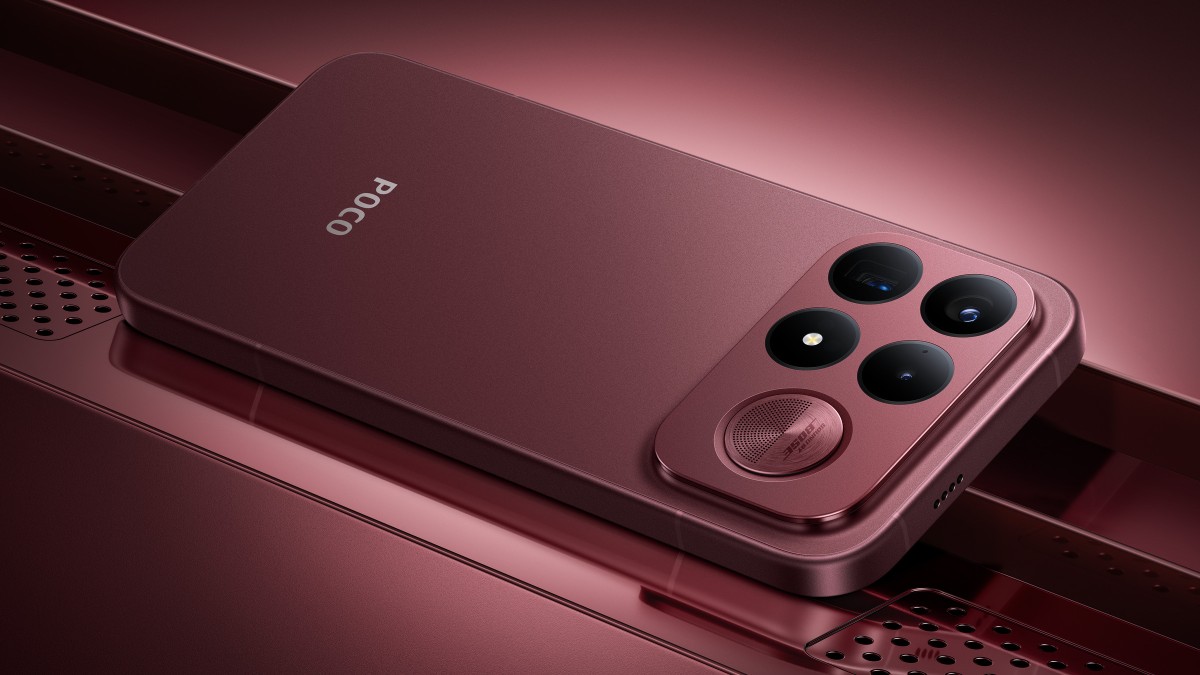
It’s the first phone in the Poco line that lets you take 200MP images, in certain conditions.
 Xiaomi
Xiaomi has announced the Poco F9 Ultra and the F9 Pro, the latest entries in its series of phones that aim to undercut the pricing of traditional flagship models while offering similar specifications. This time around, the company has included a battery with a massive 8050mAh capacity on the Ultra, and a main camera that can shoot images at up to 200MP on both phones.
That main camera is one of three: the phones also include telephoto and ultrawide options. On the Ultra, the former features a “5x” 120mm equiv. F3 optically stabilized lens and a 50MP sensor. Its ultrawide is a slightly-narrower-than-typical 0.7x 17mm equiv. F2.4 lens, also with a 50MP sensor. Xiaomi doesn’t specify the sizes of these sensors, but they seem to be unchanged from the ones found in the Poco F8 Ultra, which used a Type 1/2.76 (20.4mm2) one for its telephoto and Type 1/2.88 (18.6mm2) for its ultrawide, according to GSMArena. The F9 Pro, meanwhile, has a 50MP 2.5x telephoto camera and an 8MP ultrawide option, again seemingly unchanged from its predecessor.
 Xiaomi
The main event, though, is the 200MP wide-angle camera shared by the two models. It has a 24mm equiv. F1.7 stabilized lens. By default, it bins all that resolution down to 12.5MP or 50MP, depending on a setting, but you can access its full resolution via a dedicated mode in the camera app. The pictures take a few seconds to process, and won’t have the HDR effect that you get from the phone’s normal modes, but can show much more detail when shot in ideal conditions; the camera reminds you that the mode works best when there’s plenty of light, for reasons that are obvious if you understand how quad bayer sensors work.
Again, Xiaomi hasn’t said what size sensor its main camera uses, beyond claiming that it uses “2μm 16-in-1 Super Pixels.” That figure shouldn’t be taken literally, though, because to fit 200MP worth of 2μm pixels, you’d need the area of a full frame sensor, which it certainly isn’t. It’s more likely that it’s describing the binned quad bayer pixels, which would put the sensor somewhere around a Type 1/1.56 (50mm2). That would also explain why the company hasn’t advertised the size, when it did for the Poco F8 Ultra, which used a larger Type 1/1.31 (72mm2) sensor for its main camera. We’ve reached out to Xiaomi to ask for specifics, and will update this story if we hear back.
Of course, with flagship cameras the sensor specs aren’t everything, as phones make heavy use of computational photography, stacking multiple frames together. You can see our sample gallery shot using the Poco F9 Ultra below.
Beyond the cameras, the Poco F9 phones have relatively high-end specs. The Ultra uses the Snapdragon 8 Elite Gen 5 chip, while the Pro uses the slightly cut-down “V” variant of that system on a chip. Both feature displays capable of going up to 185Hz, and producing 10,000 nits peak brightness, though the latter figure is only over a 1% region of the screen. More realistic is the 4500 nit peak brightness figure, attainable in a window covering 25% of the display. The Ultra’s display is 6.9″, while the Pro’s is 6.59″.
Both phones have relatively large batteries for their size, thanks to the company’s use of silicon-carbon battery chemistry. The Ultra is rated for 8050mAh, while the Pro is 6330mAh. Whichever one you go with, you can recharge it quickly with the correct equipment; they both have 100W wired and 50W wireless charging. What’s more, they can be used to charge other devices that don’t have the same stamina, with 27W of reverse wired charging and 22.5W of reverse wireless charging.
Finally, the phones feature “Sound by Bose” co-branding. On the Ultra, this means stereo speakers combined with a subwoofer that lives alongside the camera modules on the plateau (though the Pro misses out on that feature). Based on the few songs I listened to, it indeed produces pretty impressive bass for a phone. If you go above around 75% volume you’re liable to hear some peaking, but for personal listening that’ll be plenty loud.
The F9 Ultra comes in “dark cherry” or black, while the Pro is available in black, white or “aurora green,” with the latter literally glowing in the dark after being exposed to light. The Ultra is available with 256GB of storage and 12GB of RAM for $799 / €1,099, or you can upgrade to 16GB of memory with 512GB or 1TB of storage for $949 / €1199 and $1199 / €1399, respectively.
Please do not reproduce any of these images on a website or any newsletter/magazine without prior permission (see our copyright page). We make the originals available for private users to download to their own machines for personal examination or printing; we do so in good faith, so please don’t abuse it.
Loading gallery…
Want to stay up to date on the latest product news and releases? Add DPReview as a preferred source to ensure our independent journalism makes it to the top of your Google search results.

What's Your Reaction?
 Like
0
Like
0
 Dislike
0
Dislike
0
 Love
0
Love
0
 Funny
0
Funny
0
 Wow
0
Wow
0
 Sad
0
Sad
0
 Angry
0
Angry
0












Comments (0)