

Four Counterintuitive Photography Habits That Actually Work
Most photography advice tells you to learn more, shoot in manual, and chase the perfect trip. Doing the opposite of all three might improve your work faster than any tutorial ever could.
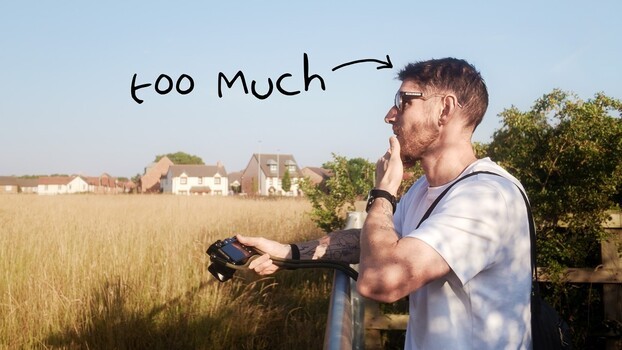
The idea that you should stop learning sounds absurd on a channel built around teaching, but that's exactly the argument Rick Bebbington makes as he cycles around his local area with an X100 in the summer heat. Information is endless now, and Bebbington's point is that constantly absorbing it leaves you overwhelmed rather than skilled. Most of what you watch never settles because you never put it into practice before moving to the next tip. His suggestion is to shoot until you hit an actual problem, then go looking for the answer to that specific problem, then repeat. Learning tied to a real need sticks, while learning collected in advance just piles up unused.
Burnout gets the same treatment. Bebbington admits he felt burned out making videos, and the common advice to push through it made things worse in his experience. What worked was filling the gap with a different creative activity, which for him meant doing more photography while stepping back from video. He points out that the best artists spend real time at rest between creative pushes, and that forcing yourself through exhaustion usually means you'll need even more time away later, or you kill the interest entirely. This runs directly against the productivity mindset most of us have absorbed, and that friction is the whole point.
Two more ideas round out his approach. The first is going out with zero expectations, since expecting a good shot every single time slowly turns disappointment into avoidance, and eventually you stop picking up the camera at all. The second is shutting off manual mode, especially if you're newer. Bebbington argues that photography is about light, composition, timing, color, and seeing, and settings are a tiny slice of that. He walks through his own setup: auto ISO with sensible upper and lower limits, a minimum shutter speed that keeps things sharp, and then playing with aperture from there. He shoots at f/8 on the X100 most of the time because he knows the scene will be in focus, and he uses the exposure compensation dial while watching the histogram to avoid crushing blacks or blowing highlights.
The local-photography thread running through the video connects to something larger happening across the field right now. As travel costs climb and more shooters talk openly about burnout, the "photograph where you live" idea has gained real traction, and it lines up with the slow-photography and everyday-documentary work that's been building for a few years. Bebbington frames his own year-long project around covering all four seasons within thirty minutes to an hour of home, and the principle transfers cleanly no matter where you are. Pick a handful of compositions near you, note how the light hits them at different times of day, and treat them as places to return to. Repeated visits teach you a scene in a way a single trip never can, and they fit into the twenty-minute and one-hour gaps that make up most of a real week. A camera like the X100 series suits this well because it's small enough to carry constantly, which is half of what makes the local approach work.
He's honest that all of this fights against the instinct for quick fixes, and that the deeper gains come from what you do daily, weekly, and monthly rather than from any single lesson. What ties the four ideas together is fun. Bebbington keeps returning to the point that most people got into photography because they enjoyed it, and expectation is what quietly drains that away. Watch the full breakdown in the video above to see how Bebbington puts all four of these ideas together on a single hot afternoon near home.
What's Your Reaction?
 Like
0
Like
0
 Dislike
0
Dislike
0
 Love
0
Love
0
 Funny
0
Funny
0
 Wow
0
Wow
0
 Sad
0
Sad
0
 Angry
0
Angry
0






Comments (0)