

Intel 14A defect density is dropping faster than the company expected — 'we have not seen this performance since 22nm,' says CFO
 (Image credit: Intel)
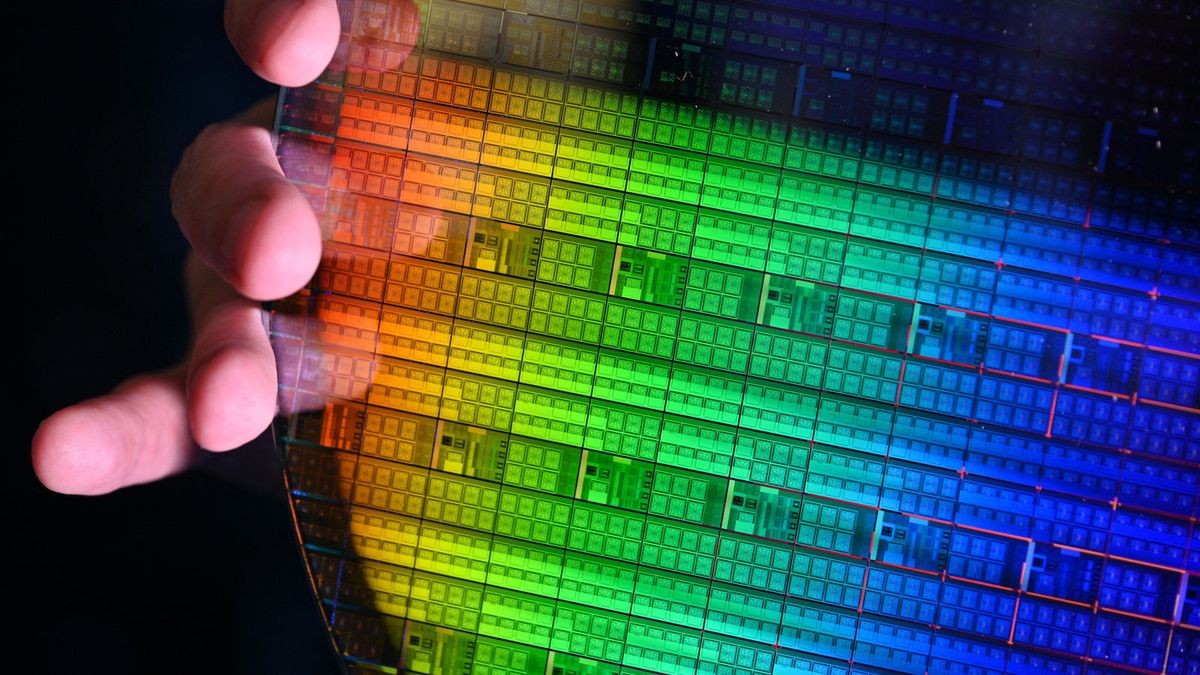
Intel's confidence in its 14A (1.4nm-class) fabrication process is rising as defect density drops. The company's own design teams are at work developing products that will use the technology, while external customers are now asking about 14A volumes Intel can get them, according to David Zinsner, chief financial officer of Intel, who spoke at Deustche Bank's 2026 Technology Conference. The CFO went as far as saying that 14A is Intel's best process since 22nm technology from the 2010's. But while the comment is optimistic, there is a caveat.
"When you look at the defect density, 14A is tracking better than the target curve we had for 14A," Zinsner said at Deutsche Bank's 2026 Technology Conference. "It is also doing better than any of the previous nodes in terms of how quickly we are bringing down the defects. In fact, we have not seen this performance since 22nm, which is arguably one of the best nodes Intel has ever put out."
Intel intends to begin risk production of its own products on 14A fabrication process in the second half of 2027 and then initiate its high-volume manufacturing in 2028, so 14A is two years away from mass production. So, what Intel's CFO said at the conference is that at this point in 14A's development, its defect reduction trajectory looks at least as healthy as the trajectory of the company's exceptionally successful 22nm process at a comparable point in its development (i.e., in 2010). There are a couple of catches with such phrasing, though. Firstly, the defect density on 14A now is not necessarily equivalent to a defect density on 22nm two years away from mass production. Secondly, due to advances of wafer processing and inspection equipment, what Intel counts as a defect now may not be the same thing as what it counted as a defect 16 years ago. Furthermore, defect density itself does not directly equal product yield.
Intel's 22nm was the company's first manufacturing process to rely on FinFET transistors and at the time was the most advanced process technology in the world; the rest of the industry moved to FinFET devices only with their 14nm and 16nm-class nodes in 2014 and 2015. By contrast, 14A will use second-generation gate-all-around (GAA) RibbonFET transistors, second-generation backside power delivery called PowerDirect, and will be able to use High-NA EUV lithography due to extremely complex patterning. Keeping all of that in mind, Intel's claim that 14A defect density reduction is progressing unusually well this far ahead of HVM is certainly good news.
Meanwhile, comparing 14A to 22nm's successors should be quite comforting for Intel as 14nm mass production was delayed by a year due to insufficient yield, the first-generation 10nm node was a failure, 20A was cancelled, 18A defect density was high even as it hit HVM milestone, while the company did not share almost any information about the progress of its Intel 4 and Intel 3 nodes.
There are good signs for 14A though: external customers are already developing products for this node, whereas the interest from external customers is now practical rather than theoretical.
"We are now seeing demand from our internal customers on 14A [and] they are actually probably the most cynical bunch out of anybody," Zinsner said. "The fact that they are now designing products on 14A was a good confidence boost for us as well. Then, engagements with customers externally, from a foundry perspective has significantly increased. Lip-Bu and the team are now meeting on weekly basis with customers. They are moving away from just looking at data to thinking about 'how much capacity can I get?' 'what does that supply look like?' So, we are now at a point where we have conviction around customers on 14A externally as well."
Intel initiated mass production of its 22nm-based Ivy Bridge processors in late 2011 and early 2012 and released them commercially in late April 2012. The product was highly successful (though overclockers did not like it because of inefficient thermal interface material between the die and integrated heatspreader), and 22nm fabrication technology served the company for many years, first for CPUs in 2012 through 2016, then for other products. Intel's 14A also promises to be a long-lasting node for Intel.
Get Tom's Hardware's best news and in-depth reviews, straight to your inbox.

Follow Tom's Hardware on Google News, or add us as a preferred source, to get our latest news, analysis, & reviews in your feeds.
Anton Shilov is a contributing writer at Tom’s Hardware. Over the past couple of decades, he has covered everything from CPUs and GPUs to supercomputers and from modern process technologies and latest fab tools to high-tech industry trends.
What's Your Reaction?
 Like
0
Like
0
 Dislike
0
Dislike
0
 Love
0
Love
0
 Funny
0
Funny
0
 Wow
0
Wow
0
 Sad
0
Sad
0
 Angry
0
Angry
0










Comments (0)