Near-packaged optics (NPO) gains ground as the industry hedges against CPO's growing pains — analysts say volume for NPO silicon photonics products will extend until the end of the decade
Aug 13, 2026 - 22:08
08
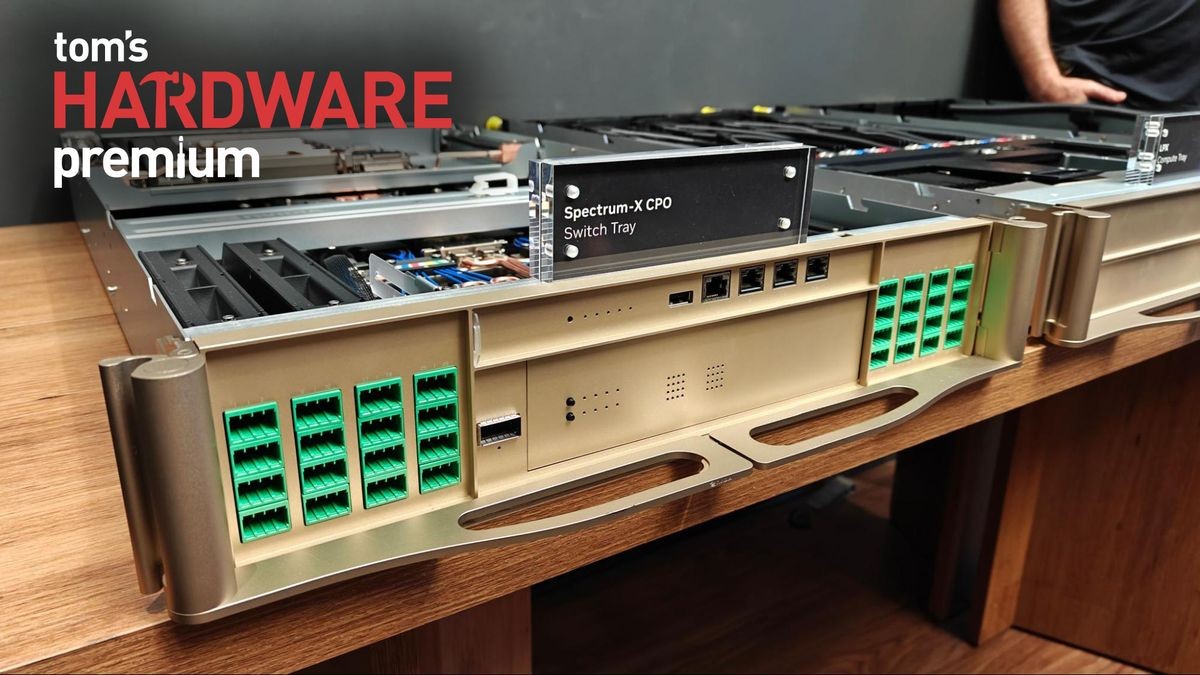
(Image credit: Tom's Hardware)
SemiAnalysis made the case for near-packaged optics (NPO) in a three-part thread posted to X on August 10, describing the architecture as an interim solution for the industry's transition from pluggable transceivers to true co-packaged optics (CPO) and crediting it with three advantages: field-replaceable modules, a failure blast radius confined to a single socketed unit, and simpler assembly, since the optical engine is packaged separately from the switch ASIC.
Just two months ago, SemiAnalysis published a research note pushing its CPO volume expectations out to 2027 for scale-out networks and 2028 or 2029 for full-scale production, subsequently knocking 17% off Applied Optoelectronics stock and roughly 8% off Lumentum in a single session and drawing a public rebuttal from rival analysts.
NPO is the architecture that stands to gain if that pessimism proves right, with Broadcom having shown a 3.2T VCSEL-based NPO product line at OFC 2026 in March, and six connector and optics firms forming a standards group the same week to define a common socket for this class of device.
NPO presents an interim solution under the transition from pluggable to true CPO. NPO has certain benefits over CPO that bypass current production and reliability challenge of CPO, while maintaining most of the benefits CPO provide.Pros:🟠 Better serviceability (field… pic.twitter.com/R4JQX2xeQAAugust 10, 2026
NPO vs CPO and pluggable optics
A front-panel pluggable transceiver sits 15cm to 30 cm of copper trace away from the switch ASIC, and the DSP that cleans up the signal after that journey draws 6W to 8W of a typical 800G module's 14 to 17W budget. CPO reduces that distance to millimeters by mounting the optical engine on the same package substrate as the ASIC, thereby eliminating the DSP. Per Broadcom, this enabled a 70% reduction in optics power for its co-packaged Tomahawk switches, and Nvidia's figures for a 1.6T link show per-link power falling from around 30W to 9W.
NPO splits the difference by moving the optical engine off the faceplate to sit beside the ASIC, close enough to shorten the electrical path and drop the DSP, but on its own engine substrate instead of the ASIC's package. The module mates to the board through a socket, so the engine can be pulled and replaced in the field in the same way that a pluggable can; an engine reflowed onto a CPO substrate can't. SemiAnalysis's January CPO deep dive defines NPO as an optical engine co-packaged onto a separate substrate that "remains socketable."
Linear pluggable optics (LPO), the other interim architecture in circulation, takes the opposite route by removing the DSP but leaving the optics in a standard front-panel module, cutting power to roughly seven to 8.5W per 800G port at the cost of reach and interoperability headaches, while leaving the optical engine on the faceplate rather than moving it next to the ASIC.
Serviceability and yield
A soldered CPO substrate has no rework path because removing a reflowed, underfilled engine means applying solder-melt temperatures of 220°C to 260°C millimeters from the ASIC and every other engine on the package, and the sub-micron fiber alignment inside the engine itself doesn't survive a second thermal excursion. One dead optical engine therefore condemns the switch ASIC, the substrate, and every other engine attached to it.
SemiAnalysis's June note ran the numbers for a hypothetical 32-engine package. At a 95% attach yield per engine, compound yield lands near 19%, or roughly one good assembly in five. GlobalSemiResearch published a point-by-point rebuttal arguing the calculation freezes yield at a single pessimistic snapshot and ignores screening, binning, and the spare engines Nvidia designed into Spectrum-X for redundancy.
Meta presented reliability results at OFC 2026 indicating co-packaged optics can beat pluggables on failure rates, and Broadcom said its CPO systems logged more than 1 million cumulative 400G-equivalent port-hours in Meta testing without a single link flap.
Lasers, historically the highest-failure optical component, sit outside the package in both architectures: the OIF's ELSFP standard, published in August 2023, defines a hot-swappable external laser module that CPO and NPO designs both draw on. Modulators, photodetectors, and fiber attach stay inside the engine, so a failure in any of those means either swapping a socketed module or scrapping a soldered one.
Shipping products and roadmaps
Nvidia's Quantum-X Photonics InfiniBand switch, which entered production deployments this year, carries 144 ports of 800G across 18 silicon photonics engines mounted on detachable optical sub-assemblies, with 18 removable external laser modules feeding them. Nvidia markets the design as CPO, but engines that unbolt from the package and lasers that slide out of the faceplate are the serviceability properties SemiAnalysis assigns to NPO. The Ethernet counterpart, Spectrum-X Photonics, is due in the second half of this year at up to 512 ports of 800G.
Broadcom runs both architectures side by side. Its 51.2T Bailly CPO switch has been in volume production at system partner Micas Networks since 2024, its 102.4T Tomahawk 6 Davisson began customer deliveries in October last year; and at OFC 2026 it added the 3.2T VCSEL-based NPO line as a separate offering aimed at buyers who want density without the soldered commitment.
Foxconn Interconnect Technology has had solderless LGA-to-LGA sockets and pluggable laser-source cages for Bailly in full production since May last year, and Ciena, Coherent, Marvell, Molex, Samtec, and TeraHop launched the Open CPX MSA at OFC 2026 to standardize a socketed optical-engine interface covering both NPO and CPO. LightCounting CEO Vladimir Kozlov, quoted in the MSA's launch release, put the stakes at "annual port shipments projected to top 100 million" within five years, against fewer than 1 million co-packaged and near-packaged ports in 2025.
TSMC's COUPE optical engine entered mass production this year in its first-generation pluggable form, with the 6.4T co-packaged second generation targeted around 2027 and a third generation moving optics inside the processor package itself. If those dates hold, NPO's run as the interim architecture lasts two to three years. If SemiAnalysis's 2029 scale-up timeline proves closer to reality, however, NPO carries the volume for the rest of the decade, adding demand to a photonics supply chain that's already short of lasers and packaging capacity.
Luke James is a freelance writer and journalist. Although his background is in legal, he has a personal interest in all things tech, especially hardware and microelectronics, and anything regulatory.


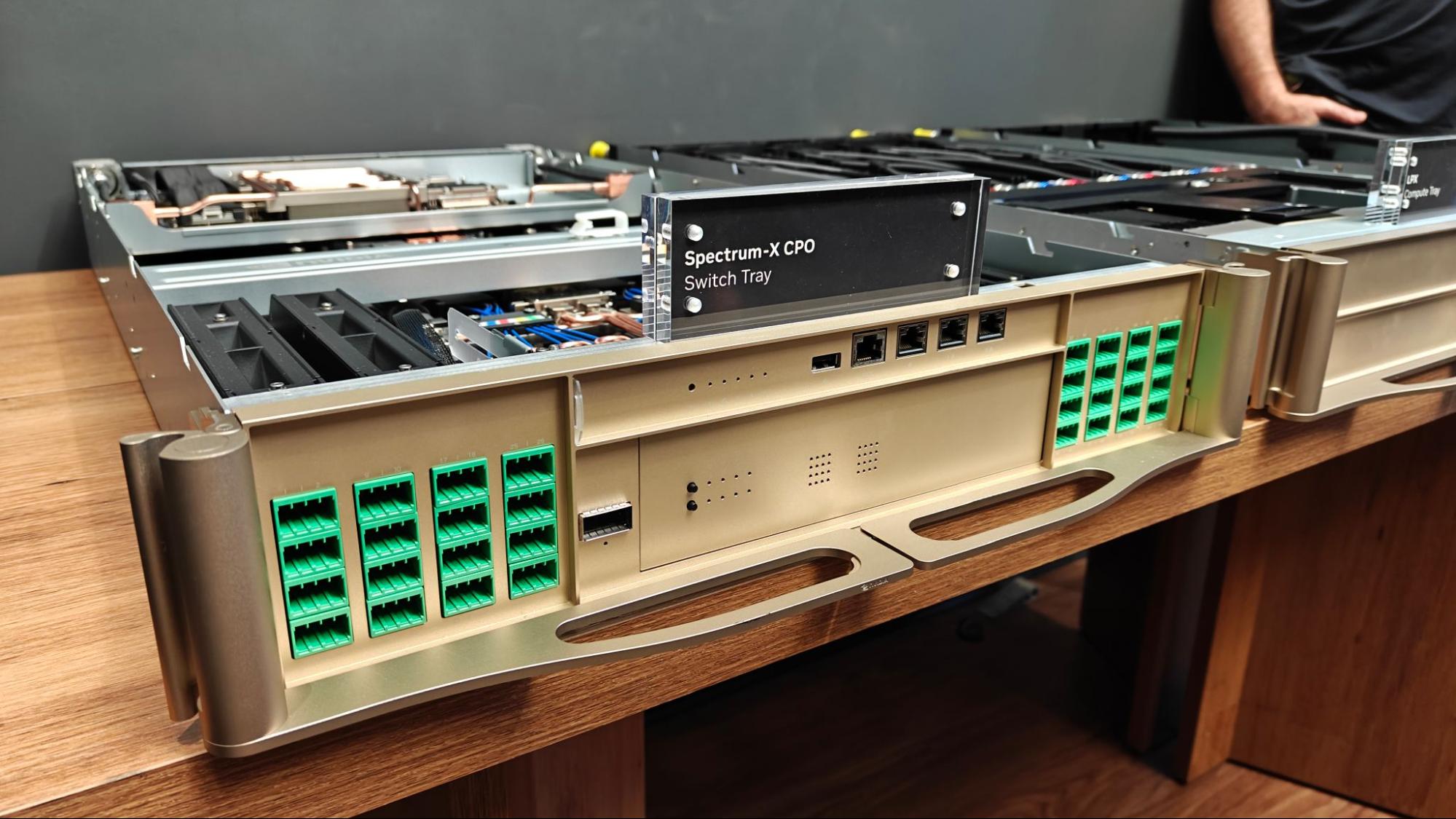 (Image credit: Tom's Hardware)
 Like
0
Like
0
 Dislike
0
Dislike
0
 Love
0
Love
0
 Funny
0
Funny
0
 Wow
0
Wow
0
 Sad
0
Sad
0
 Angry
0
Angry
0






Comments (0)