

The Canon EF 50mm f/2.5 Compact Macro Is 40 Years Old. Here's How It Holds Up.
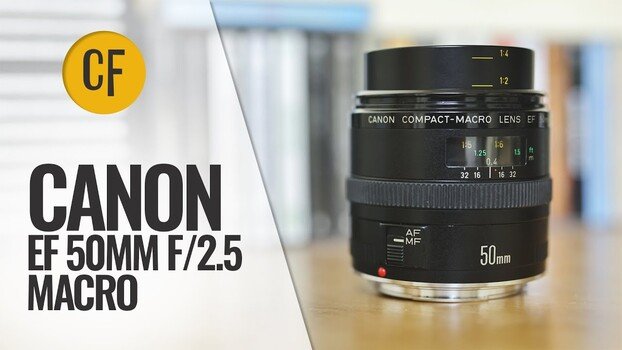
Canon's oldest EF mount lenses are worth a second look now that they adapt so cleanly onto modern mirrorless bodies. The Canon EF 50mm f/2.5 Compact Macro is one of the more interesting cases: a lens from 1987 that regularly sells for under $100 on eBay and still communicates fully with current Canon R-series cameras, including in-body stabilization and in-camera corrections.
Coming to you from Christopher Frost, this detailed video puts the EF 50mm f/2.5 Compact Macro through a full optical workout on both the Canon EOS R5 and the Canon EOS R7. Frost notes upfront that Canon marketed it as "compact macro" for two reasons: it's physically small, and it only reaches half life-size magnification. Full 1:1 requires Canon's Life-Size Converter EF, which is rare and still commands over £100 on its own. Frost's take is that a set of cheap extension tubes might be a more practical path to full magnification. The build quality is a genuine highlight here, metal and plastic construction with a metal mount, a clutch-style manual focus ring with a long travel, and a surprisingly solid feel for something made nearly four decades ago.
On a full frame body, center sharpness at f/2.5 is strong, but the corners are soft and purple fringing on high-contrast edges is noticeable. Stop down to f/4 and the image quality improves meaningfully; by f/5.6 the corners are genuinely sharp. On the Canon EOS R7's APS-C sensor, the crop factor slightly mitigates the corner softness, but it amplifies the chromatic aberration. Frost's conclusion is that shooting wide open on either body involves real tradeoffs, and f/5.6 is where this lens starts to feel like it earns its keep.
The autofocus deserves a specific callout. Canon's Arc-Form Drive motor, used here, is slow by modern standards and loud enough that it could realistically spook small subjects during macro work. That's a practical limitation worth knowing before you commit to this lens for wildlife or insect macro. Close-up image quality is another area Frost covers in depth, with some real surprises at f/4 and f/5.6 that shift the picture considerably. He also runs through flare resistance, coma, sunstars, bokeh character, and chromatic aberration, all of which show up with varying degrees of impact depending on your aperture and shooting situation. The bokeh at wide apertures is one of the more pleasant surprises. Check out the video above for the full breakdown from Frost.
What's Your Reaction?
 Like
0
Like
0
 Dislike
0
Dislike
0
 Love
0
Love
0
 Funny
0
Funny
0
 Wow
0
Wow
0
 Sad
0
Sad
0
 Angry
0
Angry
0










Comments (0)