

12 home solar power myths you shouldn't fall for in 2026

Follow ZDNET: Add us as a preferred source on Google.
ZDNET's key takeaways
- Solar savings depend heavily on location.
- Solar panels can cause burns, shock, or death.
- Plug-in solar needs a battery during power cuts.
Renewable energy is a topic that seems to be mired in a fog of war of myths and nonsense. It seems that everyone has an opinion, and a polarized opinion at that, and myths and nonsense are common on both sides of the debate. And these myths aren't helping people who want to figure out if solar is for them or, if they've taken the plunge, get the most out of their investment.
Also: Considering plug-in solar? My expert advice after setting up the DIY energy tech at home
Time to do some mythbusting. I've been using portable solar generators and solar panels for years, from small 100 W portable units to arrays that can capture thousands, to simple but effective plug-in solar systems that shave a few bucks a month off the power bill. I know what I'm talking about, and I'm happy to tell it like it is.
Myth 1 (and 2): You'll save loads/none at all from solar panels
The more prevalent solar myths revolve around how much money a solar system can make. Either there's an exaggeration, and it's going not only to save money, but make hundreds (or even thousands), or it's never going to make its money back, and it's all a waste.
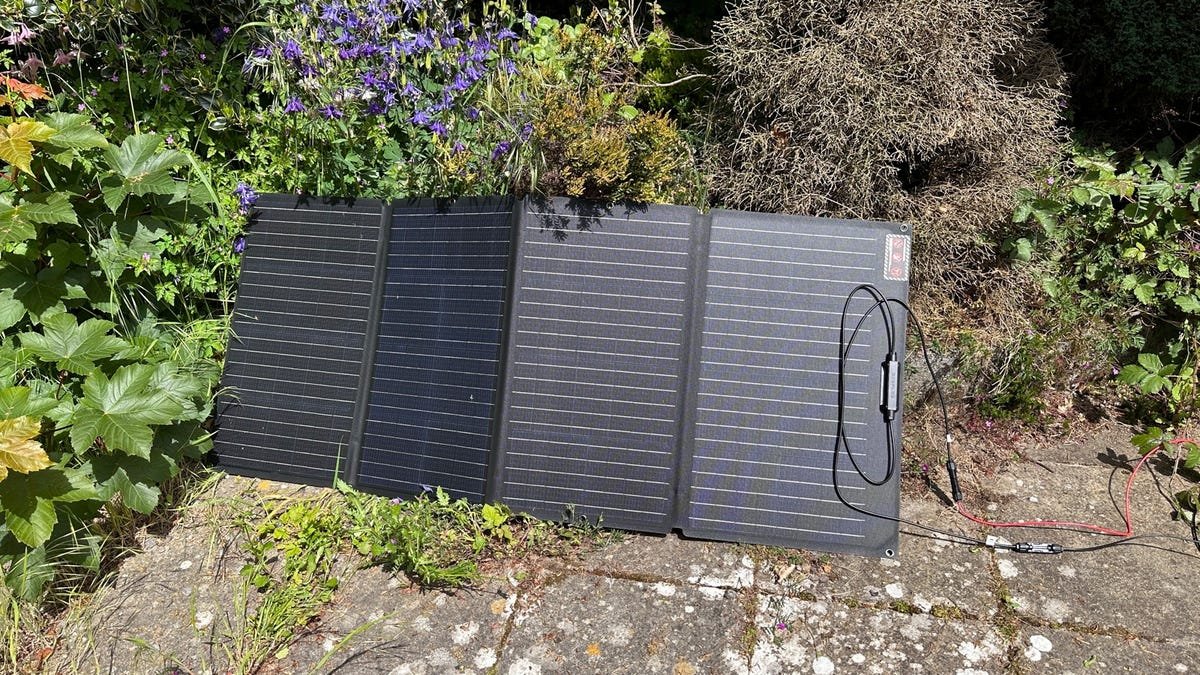
My Jackery solar generator hard at work in Scotland.
To figure out how much money a solar system can possibly make, you need to know three things:
- The size of your solar array (measured in watts)
- How many peak sunlight hours (PSH) you get at your location
- The price of electricity in your area
I'm going to take Utah as an example here, a state where plug-in solar is legal, which means that residents can legally plug microinverter solar systems of up to 1,200 W directly into standard electrical outlets. So, let's say you max out and get 1,200 W of panels. I'm going to assume that these are properly installed -- south-facing in a spot that's not shadowed by trees or buildings.
Also: Is plug-in solar legal in your state? How to check before setting one up at home
To find your peak sunlight hours, you can grab a ballpark figure from here, or you can get monthly figures from here and take an average. The ballpark figure for Utah is 6.5 hours per day over a year, while the average is closer to 5.5 hours. Let's split the difference and say 6 hours.
As for electricity prices, Utah residents pay $0.14 per kWh.
So, using the size of the solar panel array (1,200 W) and the PSH (6 hours), and factoring in losses of 23% through inefficiencies, shading, and dust and dirt on the panels (called derate), we get the following:
6 x 1,200 x 0.77 = 5.5 kWh per day over a year.
Factoring in the price of electricity, that's $0.77 a day worth of power, or $281 per year. EcoFlow makes a system -- the STREAM -- that comes with solar panels and a battery to store the excess power for $1,600 -- a system that should pay for itself in about five and a half years.
Also: How my portable wind turbine compares to solar panels - 2 years of testing later
Different areas where the PSH and the cost per kWh are different will have different figures. California, with PSH of 7.5 hours and power costing up to $0.36 per kWh, would be harvesting around $910 a year. Compare this to Alaska, with PSH of as little as 2 hours and power costing $0.27 per kWh, where a household would get only $182 worth of power a year.
More sun equals more power equals faster return on investment.
Myth 3: Solar panels are safe
Here's where I need to urge caution. A lot of caution.
Electricity is dangerous, and messing about with it can kill, maim, or injure someone instantly. This, combined with there being no end of nonsense, misinformation, and disinformation surrounding electricity, means that things can get confusing. Sayings like "it's not the volts but the amps" are totally incorrect but persist (1 amp coming from a mains outlet at 110 volts kills, but you can touch the terminals of a 12-volt car battery that can deliver 1,000 amps with your bare hands).
Solar panels are a weird thing because any time they are out in daylight, they are on and producing electricity.
Also: Years of emergency prep taught me how to storm-proof my solar generators
Also, according to the Occupational Safety and Health Administration (OSHA), any voltage of 50 volts (AC or DC) or higher is "a widely recognized threshold for hazardous electric shock."
Folding panels like the Bluetti 350W fall under this with an open-circuit voltage of 46.5 volts, but if you start daisy-chaining panels together in series, even portable panels can exceed this voltage. Rigid panels, especially in larger rooftop installations, can output hundreds of volts.
More than enough to kill instantly.
Also: The solar-powered backup station I trust after years of testing - and why it works so well
And DC voltages can deliver nasty burns, cause painful entry and exit wounds, and result in necrosis of the injured flesh. Many years ago, I got a small DC burn on the back of my hand while messing with a piece of malfunctioning equipment, and that was super painful, got infected, and took weeks to heal -- so be warned.
I've also had a small but startling shock from disconnecting damp MC4 connectors on a solar panel. I was on the ground, so nothing bad happened, but it might've been different if I was up a ladder or in some other precarious position.
The MC4 connector is very safe - until it's broken or damaged, or damp gets into it!
The biggest risk comes from broken or damaged panels, especially connectors or wiring, but I recommend covering or flipping over even small panels, or leaving any work to the morning, evening, or nighttime just to be safe.
Myth 4: Solar panels have a short life
Wrong.
The panels that EcoFlow supplies with the STREAM system come with a 10-year warranty and should, with care, give you some 20 to 25 years of service.
Also: Is investing in solar worth it? How I'm maximizing my panels' lifespan and savings
That's plenty of time to make your money back on a system.
Myth 5: Solar panels don't work on cloudy days
Solar panels generate electricity whenever there is sunlight shining down on them. However, production drops dramatically in cloudy weather, but it doesn't stop, so you're still harvesting power.
Myth 6: Plug-in solar is illegal everywhere
If you're in the US, there are currently five states where plug-in solar has been signed into law: Utah, Colorado, Maine, Maryland, and Virginia. These states allow systems with panels between 1,200 W and 1,920 W to be connected to the home's power system without any permits.
A plug-in solar microinverter from EcoFlow.
A further four states -- New York, Vermont, New Hampshire, and Connecticut -- have passed laws, but they are awaiting governor approval (or veto). Laws are in the pipeline in a further nine states, while plug-in solar has stalled in 11 states and failed in another five.
Also: Avoid these 8 solar mistakes that cut your power output in half - I learned the hard way
Outside the US, things are equally variable, with the legality of the systems dependent on local laws.
Myth 7: Plug-in solar works during a power cut
Unless your system has a battery for storing power, plug-in solar systems power down for safety reasons when there's a power cut.
Myth 8: Plug-in solar eliminates electricity bills
Plug-in solar is designed to handle a proportion of what's called base load, which is the power that your home is using throughout the day -- stuff like refrigerators, chargers, and internet routers. Even with the biggest solar array and the best PSH possible, a plug-in solar system will power down overnight because there's no sunlight on the panels.
Also: How I boosted my portable solar panels' power by up to 30% - 11 expert-approved tips
If you want to eliminate your electricity bills, you'll not only need a lot of solar panels, but also a battery system to hold that power for nighttime and cloudy days.
Myth 9: Solar generators are only for emergencies
While they're great for emergencies, people also use these systems for camping and for saving a few dollars a day off their bills by shaving a bit off their grid consumption. The batteries are also a great way to store power during cheaper off-peak times and use it during more expensive peak times.
Myth 10: Solar panels must face south (in Northern Hemisphere)
While it makes sense for solar panels to point at the sun (and for fixed systems in the Northern Hemisphere, that would mean facing due south), east- or west-facing, or even north-facing, panels will work. The system won't be as efficient as if the panels were pointing south, but you will still get power.
It's a good idea to face your panels south if possible.
Whether it's worth it is a different question. High PSH areas will make more sense. Where I am in the UK, which gets about 2.5 to 3.5 peak sunlight hours per day, north-facing panels just aren't worth it, but even here panels that aren't pointing due south generate a decent amount of power (about 30 percent less than they'd generate if they were facing south, but it's a good idea to point them as close to south as possible).
Myth 11: The batteries in solar generators don't last long
The oldest solar generator that I own (a system made by Jackery) is about 8 years old, and both the unit and solar panels are still working. And this unit uses older lithium-ion batteries, not the newer, longer-life lithium-iron phosphate (LiFePO4) batteries.
A system like the Bluetti Elite 400 should last you many years.
A modern solar generator like the Bluetti Elite 400, Jackery Solar Generator 5000 Plus, or EcoFlow Delta Pro Ultra all come with a five-year warranty, and all use batteries that are capable of handling a daily charge/discharge cycle for a decade. I can personally attest to the longevity of these systems, and I have a number of systems that have lasted five years or more of heavy -- and mostly careless -- use.
Myth 12: Solar panels need a lot of care and are easily damaged
Solar panels -- both fixed, rigid units, and portable, folding units -- are very robust. The rigid units are vulnerable to big hailstones, and the flexible units won't like being bent the wrong way, but beyond that, they need very little in the way of care and feeding.
Also: Years of emergency prep taught me how to storm-proof my solar generators
The important thing is to keep solar panels clean. Even a light coating of dust can cut your panel output by 5%, while pollen, which is stickier and more persistent, can cut output by as much as 15%.
That's not to say panels can't be damaged. Hail, and even micrometeorites, can be a problem.
What's Your Reaction?
 Like
0
Like
0
 Dislike
0
Dislike
0
 Love
0
Love
0
 Funny
0
Funny
0
 Wow
0
Wow
0
 Sad
0
Sad
0
 Angry
0
Angry
0








Comments (0)