

Canon RF 20-50mm f/4L IS USM PZ Tested on Full Frame and APS-C
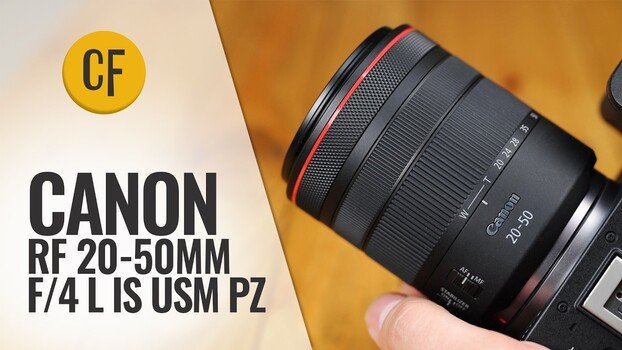
The Canon RF 20-50mm f/4L IS USM PZ is a lens built around a specific kind of shooter: someone who wants wide angle coverage, reliable stabilization, and smooth power zoom control, all in one relatively compact package. At $1,400, it sits in territory where performance has to justify the price tag.
Coming to you from Christopher Frost, this thorough video puts the Canon RF 20-50mm f/4L IS USM PZ through its paces on both full frame and APS-C bodies. Frost shoots it on his Canon EOS R5 and Canon EOS R7, which gives you a realistic picture of how it performs across Canon's mirrorless lineup. The power zoom is the headline feature here, and Frost finds it genuinely impressive. A small lever on the barrel switches the zoom ring between a standard zoom function and a zoom rocker mode, and the rocker gives you a level of precision that's hard to get from a manual ring. Slow, cinematic pulls into a scene are easy to pull off, and the motor responds naturally rather than feeling mechanical or delayed. On top of that, the lens shows almost no focus breathing, which matters the moment you start pulling focus on video.
Image quality on full frame is strong, particularly in the middle of the frame. At 20mm and f/4, center sharpness is excellent right from the start, though corners are softer. Zoom to 35mm or 50mm and the corners tighten up considerably. On the R7, with its demanding 32.5-megapixel sensor, the lens still holds up well, which Frost notes is unusual for a lens at this focal range. Stopping down to f/5.6 on the R7 gets you corner-to-corner quality that he describes as significantly better than what he typically sees from lenses tested on that body. Where things get more complicated is distortion. At 20mm, uncorrected distortion is severe, and vignetting at the far edges is so strong the corners go solid black. The lens only achieves true full frame coverage once in-camera corrections are applied, which means you're relying on software to get a clean image at its widest end.
Flare resistance lands below average, which is a real consideration if you shoot outdoors in direct sun. Close-up image quality at f/4 is soft, improving meaningfully at f/5.6 and f/8 but never reaching the sharpness you'd get at normal distances. Bokeh, as Frost points out directly, is simply not what this lens is for. At f/4 with a subject close to the camera, you can get some background separation, but the lens' design priorities are elsewhere. Canon released it alongside the Canon EOS R5 Mark II, and Frost calls that a natural pairing given that camera's video capabilities. The 20-50mm range also translates to a 32-80mm equivalent on APS-C, which makes it a legitimate option for Canon EOS R7 owners looking for an L-series zoom that actually holds up on that sensor.
Frost stops short of a strong buy recommendation given the price, but he's clearly taken with the lens's video performance and that power zoom implementation in particular. His full breakdown of the image quality comparisons, distortion samples, and real-world video footage gives you a much clearer picture of where this lens earns its keep and where it falls short. Check out the video above for the full rundown from Frost.
What's Your Reaction?
 Like
0
Like
0
 Dislike
0
Dislike
0
 Love
0
Love
0
 Funny
0
Funny
0
 Wow
0
Wow
0
 Sad
0
Sad
0
 Angry
0
Angry
0









Comments (0)