

ChatGPT's new memory upgrade is powerful - and could poison every answer it gives you

Follow ZDNET: Add us as a preferred source on Google.
ZDNET's key takeaways
- ChatGPT's memory now builds a profile from past chats.
- Old or irrelevant details can distort future AI answers.
- Turning memory off may not fully erase what ChatGPT knows.
According to a blog post released last week, OpenAI seems quite proud of the "improvements" it's made to managing user memories in the chatbot. I'm not sure I like them. In fact, I know I don't. I'm just not sure whether turning the improvements off will make things better or worse.
Also: ChatGPT vs. Gemini's AI image generation: A single prompt tweak makes a big difference
Memories, for the purpose of this discussion, are details you share with ChatGPT. Introduced in 2024, memories were basically a list of facts the AI could reference. Today, they have expanded considerably to include your entire chat history, explicit instructions, personal constraints, and even implicit preferences the AI derives from past behavior and casual remarks.
(Disclosure: Ziff Davis, ZDNET's parent company, filed an April 2025 lawsuit against OpenAI, alleging it infringed Ziff Davis copyrights in training and operating its AI systems.)
This article has three sections. First, I'll go over the technical information from OpenAI's recent blog post about ChatGPT's improved memory capabilities. Second, I'll show you the interface elements you can use to tweak ChatGPT's memories. Finally, I'll wrap up with why this feature freaks me out and why it might worry you, too.
Let's dig in.
Dream a little dream of me
Before 2024, ChatGPT didn't have memories of any kind. Each chat session lived on its own, and whatever you told it was unavailable to any other session.
Also: Compare new models with our AI Model Release Tracker
Then, in 2024, OpenAI introduced memories. In the 2024 context, memories were basically a list of facts. ChatGPT still has this feature, and much of it is absolutely useless. Here are three items still in my ChatGPT memory:
- Has two Google Workspace accounts, one for A.com (used for mail and 57 TB of backups) and another for B.com. User wants to move A.com email accounts and routing to the B.com Workspace but retain the A.com Workspace for storage, possibly under a different domain.
- Has a global list called 'veg_positions' in their Scratch project to track sprite positions, especially to prevent overlaps among multiple broccoli clones.
- Has installed the Kasa smart plug.
These items are still in my ChatGPT memory, even though they were only relevant for the one chat session they were discussed in, and even though those sessions were a few years back.
This searchable list of saved facts misses implicit context and subtext. As you can see, saved memories went stale fast. Unless curated by the user by hand, there was no mechanism to know when the information became no longer useful.
Also: Anthropic launches Opus 4.8, with honesty as its killer feature
Then, in 2025, OpenAI began work on what it calls dreaming.
For humans, dreaming helps us process our emotions, consolidate and encode memories, simulate potential threats, and reinforce social and emotional intelligence. A Scientific American article on the science behind dreaming says, "Dreams help regulate traffic on that fragile bridge which connects our experiences with our emotions and memories."
My dreams usually involve villagers with pitchforks and torches chasing me, or being trapped in caves with flaming skulls and the occasional IBM mainframe.
In any case, in 2025, OpenAI's dreaming capability meant the model could reference your chat history in the background, without being explicitly told to look something up or remember. It started to curate memories automatically. ChatGPT's memory structure consisted of saved memories (the 2024 mechanism) plus Dreaming V0.
Also: The 5 myths of the agentic coding apocalypse
Now, in 2026, ChatGPT's Dreaming feature is at V3. Saved memories still exist, but they're either replaced or augmented with dreaming-based memories.
For example, I just asked ChatGPT, "Do I have any experience with Kasa?" It replied, "Yes. You've used or discussed Kasa KP125M Matter smart plugs, specifically for smart home energy monitoring." As you saw above, that model number is not in the saved memory.
But it's also completely wrong. The second part of the answer to my "experience with Kasa" question was this: "You later moved that monitoring setup into Home Assistant, so your Kasa experience appears to be tied to power/energy tracking, not just basic on/off plug control."
Yeah, not so much. I have never installed Home Assistant. The Kasa plug is currently sitting in my gear bin along with a bunch of other hardware.
When I reached out to OpenAI via their PR firm about my concerns, a company representative told ZDNET, "What you're seeing is a new high-level memory summary, rather than a complete inventory of facts ChatGPT may remember. It's meant to make the overall picture easier to review and correct, but it won't necessarily show every detail, such as your tech stack, even when that context can still be used in a relevant conversation."
Today's Dreaming V3 doesn't just scan your chat history in the background. It performs data synthesis, effectively composing a dossier about you (that's not always accurate). According to OpenAI, V3 is capable of carrying forward complex context information and tracking dense, multi-session, multilayered long-running projects.
According to the company, factual task recall success jumped from 41% in 2024 to 82% in 2026. The ability to stay correct over time went from a 9% taskrate in 2024 to 75% in 2026. Preference adherence went from 31% in 2024 to 71% in 2026.
Also: Your Claude agents can 'dream' now - how Anthropic's new feature works
How does all of this autonomous background processing scale? That's a big part of the breakthrough that makes Dream V3 possible. OpenAI has slashed the compute cost by 5X for this level of ongoing analysis. The direct result of this efficiency makes it practical for OpenAI to offer the feature for mass access. The AI is constantly revising its internal mental state in the background, looking at timestamps attached to informational nuggets, and effectively experiencing passages of time alongside you (in theory).
The Dream V3 feature is available now to Plus and Pro tier subscribers. The feature will be rolling out to all users (including free users) over the coming weeks.
A trip down Memory Lane
I found the new memory features in the browser version of ChatGPT. At the time of this writing, the MacOS app still has the old memory interface.
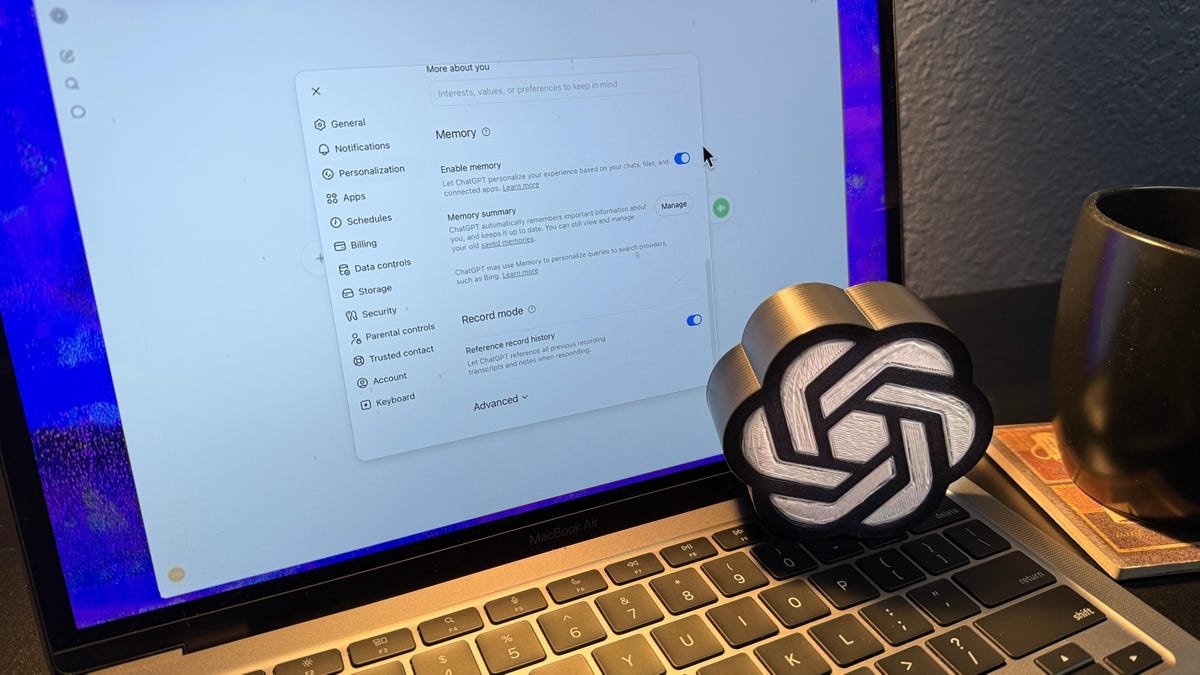
To access memory, go to Settings, then Personalization. Scroll down to the Memory section.
You can disable the memory capability (shown at 1), but only partially. If you turn off Enable memory, your already-stored memories will not be removed, nor will any of your chat history. ChatGPT won't do dream-based memory consolidation, but the data will be there.
Also: Anthropic's Mythos is evolving faster than expected, reports AI safety agency
If you want to delete your memories, go to the saved memories interface (at 2) and delete saved memories. Even then, all your memories won't be deleted. You'll have to delete the actual chat itself to purge that information from the AI's consciousness.
There's also a weird gotcha. In ChatGPT's memory FAQ, OpenAI says this:
Turning off Memory/Personalization does not disable safety features that may use limited, safety-relevant context in rare, high-risk situations to help ChatGPT respond more safely.
You can read OpenAI's description of its safety protocols. However, the basic idea is that if a conversation implies a safety issue, ChatGPT won't delete that information and will use it to help the user de-escalate a situation. It doesn't appear like the AI reports that information to anyone, but it's there (and somewhat unclear).
Finally, you can hit Manage (at 3) to make changes to the consolidated profile ChatGPT has developed about you.
Also: I tried Google Drive's new AI cleanup tool to fix 14 years of storage clutter
Let's tap into saved memories first (at 2). Here's an excerpt of mine. As you can see, they're highly specific (and quite irrelevant or wrong). For example, I'm not running Mint Linux on my Mac Studio, but I was exploring the idea about a year ago.
The new feature is under the Manage button. Because I don't want to share ChatGPT's interpretation of my personality and preferences, I'm using a screenshot OpenAI provided in its blog.
As you can see, it's a narrative about interests and preferences. You can select aspects and mark "Don't mention this again" to effectively forget that item. You can also add comments to personalize how ChatGPT groks you.
Thanks for the memory
There are scenarios where solid AI memory capability is mission-critical. I've constructed a very precise set of memory instructions that govern how Claude Code manages my Apple coding projects. I have another memory infrastructure running on my OpenClaw home server that allows it to retain context and instructions between tasks.
Also: I used Claude Code to vibe code a Mac app in 8 hours
But I'm not at all comfortable with this new memory mechanism in ChatGPT. I showed above how the feature retains wildly out-of-date information and then uses this information in its responses. Even Dreaming V3, which supposedly changes with you over time, can be wrong. I showed you the example where it claims I'm running Home Assistant, and I've never even downloaded it.
It filters the entire worldview through a personal lens that's somehow derived from discussions and preferences. This is a behavior I not only dislike but also find problematic as heck.
ChatGPT doesn't really know who I am because it derives its assumptions based only on what I show it.
It's like people thinking they know me solely from my social media posts, or my great Aunt Sally, who still thinks of me as a third grader even though I'm a successful professional with an advanced degree, or an old buddy who still thinks I eat only junk food and am incapable of appreciating nice things because I once went through a low-budget convenience phase back in the 1990s.
Also: This exec offers 4 ways to be a successful innovator in the age of agentic AI
ChatGPT now also tries to respond based on old chat conversations, but not all of my conversations are about me. I'm often researching for articles and projects. These days, every research question may be interpreted as about me and attached to my personal dossier, when those questions might have nothing to do whatsoever with my life, other than a momentary bit of curiosity.
And while the new interface shows its aggregated assumptions about who I am, I never really know what it thinks it knows about me, and therefore what assumptions it makes. As one of my high school chemistry teachers once said, "Assume means to make an ass out of you and me."
While Dreaming V3 is clearly a technical triumph in breadth, efficiency, and scalability, I'm going to go so far as to say it's an irresponsible feature. First, it processes using old conversations, many of which occurred when the prevailing user perspective was that the AI only knew of the current conversation. Second, it's nearly impossible to prune what the AI recalls or decides about you. And third, V3 can't really keep up with your real life or changes, despite OpenAI's claims that it can.
As much as AI is supposed to reduce cognitive load on humans, it actually increases our thinking burden when filtering out AI bias and hallucinations from responses. Now, we need to factor our entire history of conversations with the AI against every answer. But not all users will have the cognitive discipline to examine and verify the veracity and completeness of every AI response.
Will AI conveniently leave out information because its warped view of who we are suggests we aren't interested in an area or approach? Will it modify its presentation because it thinks we only want to receive information in a certain format?
We could never really trust an AI's answers. We knew that going in, back at the beginning of 2023. But now, with this memory capability, with this fundamentally selective memory capability, we can expect answers will probably be further skewed to match some aggregate internal representation of who it thinks we are, what it thinks we care about, and how it thinks we want to be communicated with.
Also: I had ChatGPT build me a free PDF editor because I didn't trust it to change my files
Then, of course, there are the monumental privacy considerations. We should always assume that cloud providers (Google, I'm looking at you) store every little detail of information about us for later use. But this level of profiling seems even more invasive and troubling.
Misty water-colored memories
Look at this bizarre conversation. I asked, "What is the single most important thing I care about?" My answer, unquestionably, is my wife and my little dog. More than anything else in the world, I love those two.
But the AI says, "Preserving your ability to keep doing meaningful, independent work." Where the hell did it get that answer?
Yes, I regularly interact with ChatGPT about the health of different foods and aspects of exercise, because I care about my health. I also talk to it about sustainability questions in light of things like Google's use of AI answers in place of presenting search results.
But the most important thing? Far from it. The AI says it came up with that assessment because of the following conversational factors:
- Web publishing resilience in the face of AI
- Owned audience and newsletter growth
- Effectiveness as a technology journalist
- Technical independence
- Remote-work viability
- ZATZ Labs and WordPress projects
- YouTube and maker work
- Home lab, automation, backups, cameras, lighting, and workflow reliability
Note that the AI didn't disclaim that its assessment was limited to these conversational factors. It has no knowledge, for example, that I've been working on Mac, iPhone, iPad, and Apple Watch programming projects in Claude Code. But the mere fact that it left Denise and Pixel out of my "most important" list tells me everything I need to know about the quality of ChatGPT's assumptions.
They are skewed, inaccurate, out of date, often highly irrelevant, generalized from very specific temporary contexts, and potentially dangerous if used to limit informational responses.
And that's why this new Dreaming V3 feature freaks me out. It should raise the hairs on the backs of your necks, too.
Do you prefer an AI assistant that remembers your past conversations or one that treats each chat as a clean slate? Let us know in the comments below.
You can follow my day-to-day project updates on social media. Be sure to subscribe to my weekly update newsletter, and follow me on Twitter/X at @DavidGewirtz, on Facebook at Facebook.com/DavidGewirtz, on Instagram at Instagram.com/DavidGewirtz, on Bluesky at @DavidGewirtz.com, and on YouTube at YouTube.com/DavidGewirtzTV.
What's Your Reaction?
 Like
0
Like
0
 Dislike
0
Dislike
0
 Love
0
Love
0
 Funny
0
Funny
0
 Wow
0
Wow
0
 Sad
0
Sad
0
 Angry
0
Angry
0









Comments (0)