

Derek vs Derek review – farmers go head to head in rewilding rivalry with real bite
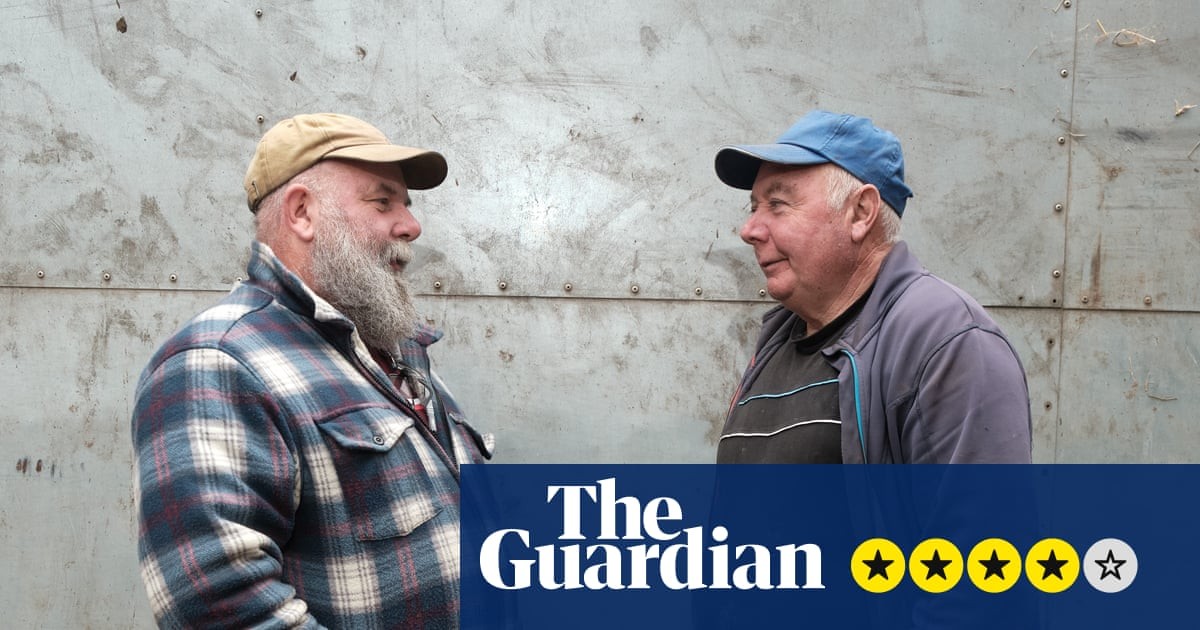
This ebulliently accessible but never tacky British documentary finds a delightfully sneaky way to explore debates around environmental damage, agriculture and the countryside without ever being preachy, dry or patronising. The trick is to find engaging characters who happen to have opposing points of view, and while by the end most viewers would reckon that the pro-environmentalists pretty much win the argument, the conservative element of the farming community gets to have its say and make its case, earning sympathy in the process for a way of life that is itself endangered, albeit partly because of its own self-destructive practices.
The twosome at the heart of the story are neighbours Derek Gow and Derek Banbury, two men in late middle age in wellies with bellies whose roughly equal-sized allotments of land (about 120 hectares) abut each other in Devon, near Dartmoor. Twinkly eyed, West Country-accented Banbury is a regular farmer like many others across the UK, rearing dairy cows and planting crops, and just about getting by as the price of milk is kept incredibly low thanks to his main customers, the supermarkets. His son works beside him and is set to inherit the spread just as Derek did, while Derek’s wife, Linda, supplements their income by running holiday cottages.
Meanwhile, across the road and behind the hedgerows that he insists not be trimmed in order to protect the wildlife living therein, is Derek Gow. He is Scottish and moved to these parts years ago; he gave up sheep farming to become a conservationist, passionately devoted to rewilding his land in order to restore the biodiversity that modern farming is gradually destroying. Salty of tongue but as smart as the beavers he champions, Gow has swapped his ovine flock for wild boar whose rootling naturally reshapes the landscape. Unfortunately, this annoys the neighbours, especially Banbury and Tony to the north, when the boar breach the admittedly flimsy-looking fencing and sometimes eat sheep. (It’s not clear, though, whether the boar killed the sheep or just chowed down on ones that died naturally, a mystery worthy of Miss Marple.) What is clear, though, is that traditional farmers will be even more hopping mad if wolves are introduced to the area, a proposition discussed at a conference that Gow hosts on his land (with guests catered to by Linda Banbury).
Director James Dawson started out making TV documentaries and there’s just the right amount of common touch to the way he sets up the antagonism between these two men – only to see it evolve into a more agreeable coexistence, perhaps even a symbiosis by the last act. What seems to win over Banbury is the case that Gow makes about declining insect populations, especially the pollinators, so crucial to farming, whose populations have reduced by as much as 70% in some areas thanks to insecticides and the monocultural green deserts that modern farming creates.
In the end, this serves up exactly the kind of film you could sit down and watch with your Countryside Alliance-supporting uncle at Christmas and see what happens. It won’t turn him into a Green party voter all at once, but it gently builds up persuasive arguments, and in any case makes for a lovely viewing experience as a nature movie, with gorgeous shots of bitey little water voles, plucky beavers and elegant storks.
What's Your Reaction?
 Like
0
Like
0
 Dislike
0
Dislike
0
 Love
0
Love
0
 Funny
0
Funny
0
 Wow
0
Wow
0
 Sad
0
Sad
0
 Angry
0
Angry
0







Comments (0)