

Director Xavier Tera and Producer Jeremy O. Harris Go Global with Venice Breakout ‘The Color of the Sun’
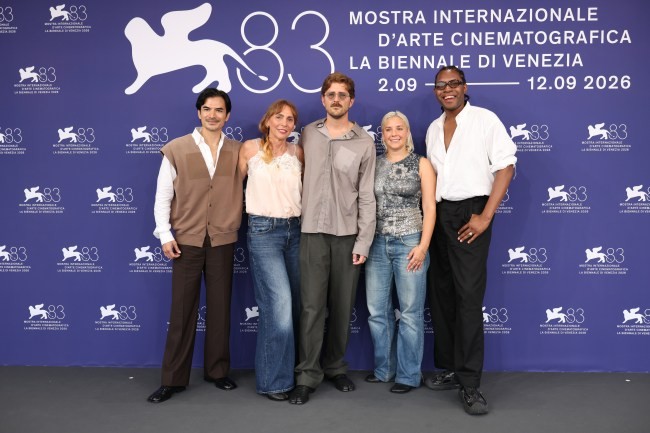
Though set in Okinawa, an island off of the coast of Japan, Venice premiere “The Color of the Sun” is a coming-of-age film of global scale. Directed by photographer-turned-filmmaker Xavier Tera, the FIPRESCI International Critics’ Prize winner for Best Film from Orizzonti reflects the complicated nature of his Québécois upbringing in addition to the decade he has spent working from East Asia.
“I grew up in a very strictly French-speaking household in a country where most people speak English. And that reason is obviously France was the first colonizer to Canada,” said Tera over drinks with IndieWire in the courtyard of the Residenza d’Epoca Albergo Quattro Fontane outside the base of the Venice Film Festival. “I grew up always questioning this idea of identity and what French represented within North America or within Canada, but also what it represented to be that person that felt overlooked by the English. But also, we were colonizers first, so we also took the land of indigenous people in Canada.”


Similarly, the indigenous population of Okinawa, the Ryukyu, do not consider themselves Japanese, having only been annexed by the country relatively recently, in the 19th century. “I’m definitely depicting a reality for these people that I’ve met in Okinawa in relation with Japan, but also with the American military that is set there,” said the first-time feature director, in reference to the military bases stationed on the island since World War II. “So I feel like I have a form of objectivity being not American, not Japanese and not Okinawan, but still relating to the identity themes.”
If that context for the environment protagonist Kamei is coming-of-age in, figuring out his sexuality and what his place in the world could be, sounds at all complicated, producer Jeremy O. Harris is here to help via his new production company bb2, co-founded with producer Josh Godfrey after the Tony-nominated playwright’s HBO development deal wrapped with more projects announced than had been actually produced.
“The thing that was most frustrating about my early career is that I don’t think I always had people who were really translating properly for me, and therefore a lot of things didn’t manifest,” said Harris, also seated with Tera at the Quattro Fontane. “That’s my greatest skill as a producer, is that directors and I can really speak a similar language and then I can take that language and explain what they’re saying to people in an interview, and also to finance people, in a way that really connects to their heart and soul.”
 ‘The Color of the Sun’Courtesy of Cinetic Media
He continued, “What all young filmmakers need, especially ones who are doing really dynamic, dangerous work, because most people heard that [Tera] was doing this queer fucking coming-of-age movie where 90 percent of the dialogue is in Japanese, and then it takes place around an American base and they were like, ‘Wait, what?’ Most people would’ve told him, ‘Well, you’re white, you’re Canadian, so it’s basically American. Flip it and make the main character the white boy.’” Harris said, “that would’ve made a much more financially viable movie. But I knew the story he wanted to tell and the emotions he wanted to tell placed him closer to the character of Kamei than the other characters. And so that had to be protected and that had to be explained. So that’s the lesson I took [from HBO], and I’m so happy that it got to happen this way.”
Speaking more to the development of Kamei, played by newcomer Naoto Shimajiri, Tera explains how the character study is not so much about capturing any anxieties Gen Z and/or the Japanese people may hold, but more so embedding his own experience figuring out his identity. “‘Am I gay? Am I straight? What is this, and what does that mean?’ That’s just a normal question that every kid is going through, and it’s a question even more so with just the idea of masculinity and seeing people in power right now that represents this hyper, really dangerous side of masculinity,” said the director. “These people are not men to me, and that doesn’t relate to masculinity in a way that I feel masculinity is for me, even if I’m straight.”
What did feel Japanese about both the script and the filmmaking is how they left certain things unsaid. “He’s such an emotive image maker. Each of the images in this sort of build upon each other in a way that as a producer was the first time I felt so in awe of what I was witnessing on the camera level,” said Harris. “It was so cool to see how much can be said without speaking and how truly moving the pictures were when I watched this film.” He added, “you got me inside of his psyche without using as many words as I would often go to as a writer. Another reason I really like producing is that I feel like from the filmmakers I’ve been lucky enough to work with, I’m getting film school. I’m learning so much about what’s important to me as a storyteller and as a watcher. So thank you.”
 ‘The Color of the Sun’Courtesy of Cinetic Media
“The Color of the Sun” was shot by cinematographer Sayombhu Mukdeeprom, a close collaborator of Thai auteur Apichatpong Weerasethakul, who has gone on to work on films like M. Night Shyamalan’s “Trap” and several Luca Guadagnino films from “Call Me by Your Name” to “Challengers” and “Queer.” The person who most helped land Mukdeeprom was producer Stella Savino, who worked on several projects with the latter director, and therefore mentioned reaching out to the cinematographer before Tera had even mentioned that he’s a huge fan.
“It just happened that he was in between two projects, which were Frank Ocean’s film and the new Apichatpong movie. And I was just this random dude in between two fucking legends. And we jumped on a few calls and we got along straight away. He’s kind of like this monk,” said the director. Their conversations ended up being more about energy levels and Buddhism than the work itself while Mukdeeprom’s wife, the owner of a Thai restaurant, would cook for them. “This guy was the sweetest and just wanted me to create what I had in mind. I’m so humbled by just his trust and his influence on the film,” said Tera.
Tera’s longtime producing partner Janie Chartier also cites connecting with the cinematographer as a breakthrough for the film. “We had so many challenges on this shoot, from a tiny budget to losing the head of our local production team right before we started filming. But we are used to having to fight to make our projects the way we want, from using 35mm, down to getting the light just right. I think that shared commitment to excellence also helped us land Sayombhu Mukdeeprom, who we feel so lucky to have worked with on ’The Color of the Sun,’” she said.
Savino added, “As a producer, I am deeply committed to debut features, and the coming-of-age genre has always been a core interest of mine. Beyond that, I was highly drawn to the prospect of collaborating with a young female producer who was coming from a completely different background. I found the challenge of merging such a rich melting pot of cultures, experiences, and generations incredibly compelling.“
Chartier also said, “Xavier and I have been business partners for almost ten years in Japan, our current home. We cut our teeth in the industry together, collaborating on countless commercial projects along the way. When Xavier decided to make his first film, it felt like the perfect opportunity for both of us to step into a new chapter.”
Tera, who had also been in a decade-long relationship with Chartier up until recently, recalled some of those difficult moments where it felt like the film may not happen. “A few times I was just like, ‘Oh, well, that was great. We tried.’ She’s like, ‘No, no, no. We’re going to find a solution.’ I’m like, ‘Ok.’ I’m talking like curling in a bed, crying, this type of situation. And she’s also crying, looking at me, and she’s like, ‘No, we’re going to make this.’ I’m like, ‘Ok,’” said the director of his fellow Twin Brains producer. “And it’s like…for me to have this person alongside me in my life is crazy because it’s my childhood dream.”
“We’ve been joking that this is kind of like their wedding in a way,” said Harris of Tera and Chartier. “Exactly. There’s so many people traveling to see us right now, family, friends from all over the world and everything,” said the filmmaker with a smile, as he was starting to well up. “Even if we’re not together anymore, it’s the love of my life in a way. So it’s great to make things with people you love.”
“The Color of the Sun,” has already lined up distribution in Canada and Italy, the two countries that served as co-producers on the film, in addition to Japan. However, the prize-winning film has not yet found one in the United States. “There’s a lot of great American distributors that I think would take really good care of this movie,” said Harris.
One part of the film that he thinks will appeal to a younger audience is “when you’re watching this movie and you’re constantly bombarded by the sounds of the American military, a lot of the conversations people are having right now about the hand America has had in conflicts everywhere, it feels really ripe,” said the producer, who recently worked with the company 1-2 Special on the bb2 production “Erupcja.” “This feels like a no-brainer for a lot of people that I really love, especially the distributors that I think are specifically supporting international movies and movies that center young people. I think they get it. They’re not chasing after a movie that’s going to have 15 names in it. They’re like, ‘Let’s discover the next one.’”
 ‘The Color of the Sun’Courtesy of Cinetic Media
In terms of what is next for the pair, Harris will continue to support first-time filmmakers, while Tera already has another film idea set in Japan. “Trying to figure out all these voices and all these stories that maybe Japanese filmmakers were less inclined to tell, that’s when I started working on this film,” he said, in reference to “The Color of the Sun.” “This other film that I started writing, and that’s evolving quite interestingly, but so different from what we just made, it’s set in Tokyo. It’s a lot more raw, a lot more intense. The cast for this one, I’m looking at Nigerian, Russian, white, kind of like a crazy nightlife ‘Uncut Gems,’ but in Roppongi, Tokyo.”
While Harris remains interested in producing that project with Tera, saying “I’m really excited about the opportunity to go back there and see Japan more through his eyes because there’s so much that he’s seen there as a foreigner that I think is really exhilarating,” the film in development that actually drew them together as friends all the way back when Tera shot Harris for a spread in GQ Japan was an adaptation of Sayaka Murata’s “Earthlings,” a novel Chartier has the rights to.
“All her books are great, but this one really touched us from the get-go,” said Tera of the acclaimed Japanese novelist. “It’s a book I literally send to every actress. I sent a copy of it to Ayo Edebiri. I sent a copy of it to Zendaya. I’m constantly sending people this book being like, ‘You need to read this book. There is no female character as interesting as this woman.’ It’s so good,” said Harris.
“The Color of the Sun” premiered at the 2026 Venice Film Festival.
What's Your Reaction?
 Like
0
Like
0
 Dislike
0
Dislike
0
 Love
0
Love
0
 Funny
0
Funny
0
 Wow
0
Wow
0
 Sad
0
Sad
0
 Angry
0
Angry
0







Comments (0)