

Leica Announces the SL3-P
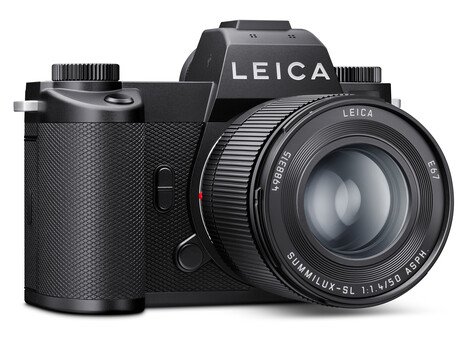
A new Leica camera always attracts attention. And while the M line is the brand's most famous line, there are many devotees of the SL system, which is a more contemporary system akin to cameras offered by Nikon, Canon, and Sony. Today, Leica announced the newest iteration, the SL3-P, a 44-megapixel camera designed for both speed and performance.
The SL system debuted in 2015 and currently consists of two models: the SL3 and the SL3-S. I spoke with Nathan Kellum-Pathe, Trade & Retail Marketing Manager, Marketing Department, Leica Camera Inc., who explained why Leica created a third iteration of the SL.
“It has really been all about customer feedback. When we introduced the SL3, people loved its 60-megapixel sensor and 15-stop dynamic range. But we had customers saying, ‘With this resolution, I feel like the autofocus may not be quite as fast for some of the needs that I have.’ So we introduced the SL3-S, which has much faster autofocus and substantially improved video applications, up to 6K RAW, with that 24-megapixel sensor.
I think Leica was satisfied with those two cameras as offerings to our customers. But the feedback we received was that customers were saying, ‘Can I get the best of both worlds? Can I have a camera that's both fast in autofocus and has a higher-resolution sensor than the 24 megapixels you offer in the SL3-S?’ The SL3-P represents the most complete SL camera to date, based on customer feedback saying ‘this is really what I would like to see from the SL,’” said Nathan.
While it wouldn't be wrong to assume that the P stands for professional performance, Leica is known for paying close attention to how the camera is designed. There is a large screen on the back with three buttons reminiscent of the Leica M11. Three well-placed dials can be set to control the exposure triangle. Five buttons can be set to a variety of custom functions.
“The whole point of the system is that we want it to become your camera, for you to customize,” said Nathan.
Pushing a custom button once activates its custom function. To change its function, simply long-press the button to see other custom functions available. This makes it simple to use a button to set a custom white balance for a scene before you begin your shoot, and then change that button to a function that will be more useful during the shoot.
You can also create custom profiles. You might have one labeled “Portrait” that has face detection autofocus activated along with black and white image capture. Another profile might be called “Event” and capture images in JPEG format only. In a demonstration given to me by Nathan, it appears to be simple to create and modify these profiles. Video profiles can be created similarly. One clever feature of the SL3-P is that highlighted items appear red in photo mode and green in video mode, making it easy to distinguish which mode the camera is in.
Like the Leica M11, there is a quick menu that shows an overview of what is happening with the camera—from battery life to number of shots left. You can add your eight most-used settings to the bottom of that page for quick access. Leica's vision is for a new SL user to spend a few minutes creating profiles and customizing buttons. Once that has been accomplished, the user will rarely need to access the menu.
The SL3-P is IP54 rated, meaning, in a practical sense, the camera is waterproof. If you were shooting in the field and it started to rain, you could confidently continue shooting without fear of water damaging the camera. SL lenses don't have a specific IP rating, but I believe you can expect similar performance to that of the SL3-P body.
Despite the SL system cameras being state-of-the-art in their performance, Leica isn't looking to impress people who judge cameras based on the number of buttons and dials on the body and what the specs look like on paper.
“We see this all the time in the industry. A camera comes out, and it beats a certain spec, and suddenly that's the headline. This camera is for creators who value craft. For us, the inspiration behind this camera is designing something for people who don't know what their future assignments will be. We want them to have the trust and confidence that no matter where their job or creativity takes them, this is the tool they'll use. It could be anywhere, anytime, any subject. This camera is ready,” said Nathan.
Along with the SL3-P, Leica announced the development of two new lenses—the APO-Macro-Elmarit-SL 100mm f/2.8 and a new version of the Summilux-SL 50mm. Of the two, I found the 50 Lux to be most interesting, despite it being a new version of an already existing L-mount lens. Leica lenses are often known for having character, a quality that cannot be described on paper. Most lens makers strive to make every lens the best in its class. This distinction can be measured through charts and image tests. While this is a respectable approach from a technical standpoint, this isn't the only way to design lenses. Leica often offers more than one lens of a particular focal length, each offering a different rendering. Users take to forums to debate which lens is best, based not on charts, but on how their favorite subjects look when captured by the Summilux, Summicron, or APO version of that focal length. When shot wide open at f/1.4, the new 50 Lux is designed to render a scene the way an M mount 50 Lux renders. Stopped down, the lens quickly achieves technical perfection.
I attended the launch event for the SL3-P in NYC, which began at 9 a.m. and drew more people than I expected. Along with an introduction to the camera, there was a panel discussion hosted by Brandon Ruffin and featuring Mark Mann and Melissa Field.
Mark Mann spoke of not being a technical photographer and how he was surprised that the increase in autofocus performance has resulted in more keepers. People tend to perform for the camera, even when they are not trying to, and the SL3-P helps him nail shots he might have otherwise missed. “The in-between moments feel authentic—a peek into the soul—but it's a fraction of a second. If you get that moment slightly out of focus, it can distract from what was happening. Better autofocus is always a good thing. When I'm making portraits, I spend so much time having a conversation that I often forget to take pictures. Knowing that the ones I did take will be sharp is very helpful,” said Mark.
Brandon spoke of the barriers portrait photographers must overcome in creating portraits and how he sees those walls as a series of bricks that he aims to remove one by one. “The less you fiddle with your camera, the more it becomes something you're comfortable with, so it almost doesn't exist. You have to start taking those bricks down, brick by brick, when photographing people. If you miss focus and need to take it again, the bricks might start going back up, and it's harder to remove that wall,” he said.
“In a world where you can create a picture by typing a prompt, there is something sacred about creating a picture through the process of photography,” said Brandon.
What's Your Reaction?
 Like
0
Like
0
 Dislike
0
Dislike
0
 Love
0
Love
0
 Funny
0
Funny
0
 Wow
0
Wow
0
 Sad
0
Sad
0
 Angry
0
Angry
0








Comments (0)