

Let Tom Hiddleston be your guide to Pompeii's final day
NatGeo’s Pompeii: Out of Time fuses historical fact and imagination to bring city’s last 24 hours to life.
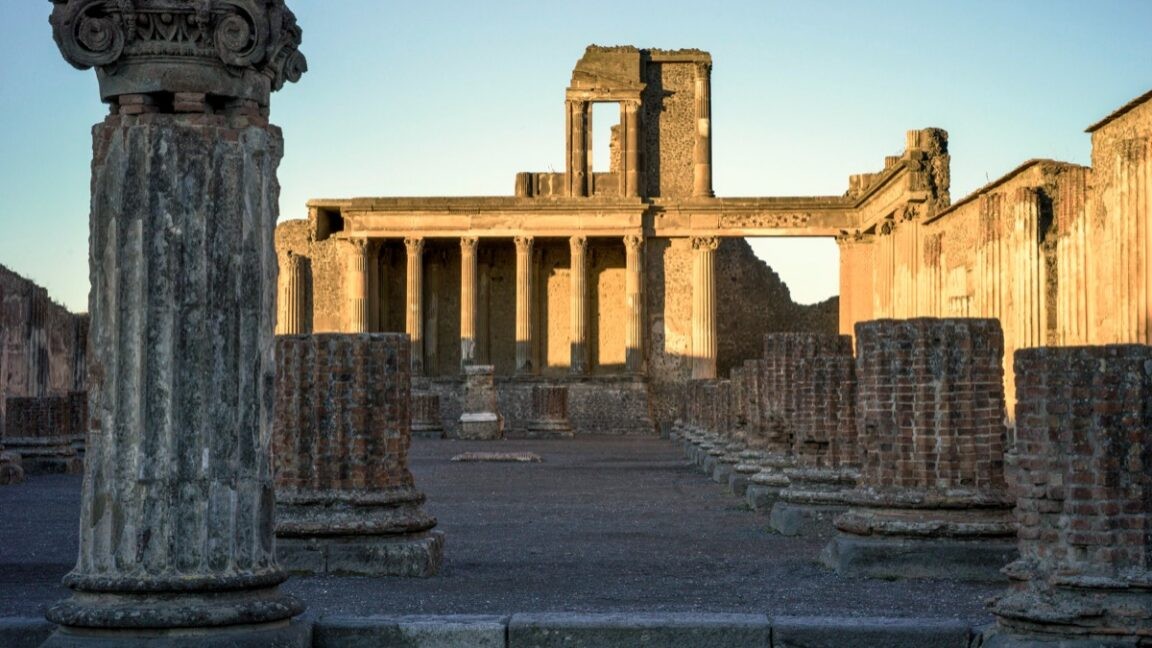
The sun rises over colonnade ruins at Pompeii. Credit: National Geographic/Paolo Verzone
When Mount Vesuvius erupted in 79 CE, it spewed molten rock, pumice, and hot ash over the cities of Pompeii and Herculaneum, killing thousands of people. It’s one of the most famous natural disasters in human history, so naturally there have been countless documentaries about Pompeii (and at least one popular song). But only one features actor Tom Hiddleston taking on the role of a “time detective” to bring the people of Pompeii to vivid life. That would be National Geographic’s new three-part docuseries, Pompeii: Out of Time.
The Marvel connection made Out of Time happen. Executive producer Kevin Wright was also a producer on the Disney+ series Loki, which included a scene where Hiddleston’s Loki travels through time to visit Pompeii. Hiddleston also studied classics at Cambridge University and had visited the Pompeii archaeological site as a teenager, which the Marvel star attributes to indirectly influencing his career path into acting.
“There is just a passion to the way Tom tells stories that’s infectious,” Wright told Ars. “We knew that if we could capture that and put it into [the series], it might interest people who wouldn’t normally want to watch a documentary about Pompeii. “
The docuseries combines the usual historical and scientific facts with Hiddleston’s personal journey of discovery. He homes in on three people in particular and follows them over the city’s final 24 hours to discover whether or not they survived: a teenage boy, a local businesswoman, and a Praetorian guard. Stilted re-enactments are replaced with scripted dramatic scenes and high production values to make it all feel more cinematic. It’s an unusual approach, if only because we’re so conditioned to what a documentary “should” be. But the blended approach makes for a powerful experience.
“We felt we could use the imagination to make a more human story. This isn’t just ancient history; these were real people, and their lives were not dramatically different than ours even though they lived 2,000 years ago,” said Wright. “One of the most freeing moments was when we came to this idea of ‘historia,’ the merging of imagination and historical fact, and that ‘storytelling’ and ‘history’ in Latin are the same word. It was Hiddleston who put us onto that. When we went to our historians, our experts, with that word, we were met with nothing but enthusiasm. There seems to be a real movement in archaeology of, ‘This is how you have to approach it now.’”
A time detective
Factual science does get its due. Geologist and science communicator Chris Jackson, for instance, is on hand to clear up any misconceptions the general public might have about the eruption and its aftermath. “The most common misconception people have about Pompeii was the belief that people were killed by lava,” Jackson told Ars. “That’s understandable. In Pompeii and Herculaneum, around all of Naples, a lot of the buildings are made from these black hard igneous rocks, cooled lava. When you tell people that what led to the devastation in 79 AD was nothing to do with lava, their faces sort of drop. It’s a bit sad to hear that it was this more devastating thing called a pyroclastic flow.”
Outrunning those flows would not have been an option. Based on reconstructions, Jackson estimates that the pyroclastic flows would be moving between 100 and 200 kilometers per hour (60–120 mph). “Imagine the speed you can drive on the freeway in the US and double that,” he said. “You can’t outrun a car. So there was no way you were going to outrun these things. That’s what makes these so devastating. And remember the depth perspective. It’d be traveling a few hundred kilometers an hour. But to you from 10 kilometers away, you’d be like, ‘That’s going pretty slowly.’ So it needs to be seen through the lens of the understanding of people 2,000 years ago.”
The eruption of Vesuvius dramatically altered the geography of the Bay of Naples, per Jackson. “These pyroclastic flows actually changed the shoreline shape,” he said. “Some went through Vesuvius and Pompeii, which at the time had beaches. They were next to the sea. Now there’s some distance from it because [the flows] added new land beyond the settlement and reshaped the coastline.” The eruption also triggered a small tsunami.
That said, “A lot of what’s causing some of the strange shape of the Bay of Naples is actually related to another volcano to the northwest of Vesuvius that nobody talks about, Campi Flegrei,” said Jackson. “Nobody makes TV shows about Campi Flegrei, but that’s a supervolcano. The eruption of that in the geological past is actually what’s believed to have caused that big bite in the bay.”
The human factor
A CGI depiction of the Roman city of Pompeii as it might have appeared in AD 79 with Mount Vesuvius erupting in the background, its ash column expanding like an umbrella. National Geographic
Wright didn’t have a Marvel budget for Out of Time, but he did have the expertise of showrunner Tom Barbor-Might. “As you’re writing [the script], you have to put out of your mind how to actually shoot this,” said Wright. “It really is, how do you tell the best story? But Tom could keep that whole vision in his head. A volcano has to go off in this story. It has to look good. It has to look engaging. And that comes from having people at the helm like Tom who know how to break this down.”
“You have to be very precise in how you budget this, how you shoot it, how you storyboard it,” Wright continued. “Sometimes you need that big VFX shot, you need the big drone to sell the story, because that’s the only way you can do it justice. That was where the worlds really merged. I was able to bring some of my experience from Marvel. Tom was able to bring his experience to get that Marvel production value, but with a small footprint. Maybe we don’t need a hundred people on set. Maybe we can do this with 10 people and our actors.”
Even simple and cost-effective special effects can turn out to be emotionally evocative on screen, such as the wispy flakes of falling ash that rain down on Pompeii in the immediate aftermath of the eruption. “That was all practical,” said Wright. “We have some VFX in there, but the soft falling ash—we worked with a really amazing Italian special effects team that figured out how to safely blow a bunch of stuff into the air that was safe for our actors and looked great on camera. A lot of it was just newspaper and things like that. It was a nice merging of old and new techniques.”
The team also hired high-caliber professional actors to perform the scripted scenes. “The word docudrama has a stigma to it,” said Wright. “I think National Geographic very generously is saying, ‘We’re coming up with a new form of storytelling.’ It’s always been there; we’re just trying to refresh it. A big part of that is the drama’s got to be real. The mistake a lot of those shows maybe made in the past is your experts, your historians, your presenter tells you something, and then you just see that thing exactly as you were told. What we were trying to do was bring to life these people’s emotional interiors. And to do that, you have to have great actors.
Credit: National Geographic
“Luckily, we were based out of London. A lot of great actors are based around there, and there were others like Lubna Azabal who plays Julia Felix. She was the lead in an amazing movie [directed by Denis Villeneuve], Incendies. The casting was just as important as hiring our cinematographer or our production designer. You’re really looking for people that get the material and understand, ‘Hey, you’re not just in a flashback.’ Hiddleston might not be on-screen with you, but he’s saying something that is going to bring your character to life. You’re going to do something emotional that he has to react to emotionally.”
The famous plaster casts of the victims don’t appear in the documentary until the very end—a very deliberate choice. “We felt that the plaster casts had been, just through sheer passage of time, decontextualized a bit,” said Wright. “You can go to Pompeii. It is an active archeological site. It is also a tourist site so [the plaster casts] become props for photos. We wanted to help reframe them in the pop culture: This is a grave site. The person in any of those casts had a story. We chose three of those stories. There are hundreds of stories, maybe thousands. That was something from the very beginning: How can we add some power back to these people and some respect? If you really sit with it, it’s incredibly moving.”
“If somebody were to follow you and I around and write down everything we did today, you would have all the facts, but it would be missing your emotional context, your interior life context that you can only get through psychology, through imagination, through the cultural storytelling,” said Wright. “The history will only get you so far. The only way you can fill in those gaps is through those techniques. We can’t go, ‘Hey, that’s exactly what happened.’ But as one of our experts says, ‘That’s a story that we could believe. That is a story we know could be true.’”
Pompeii: Out of Time premieres on July 21 on National Geographic, and it will be available for streaming on Disney+ and Hulu the following day.
A view of the archaeological site Herculaneum. National Geographic/Paolo Verzone

Jennifer is a senior writer at Ars Technica with a particular focus on where science meets culture, covering everything from physics and related interdisciplinary topics to her favorite films and TV series. Jennifer lives in Baltimore with her spouse, physicist Sean M. Carroll, and their two cats, Ariel and Caliban.
What's Your Reaction?
 Like
0
Like
0
 Dislike
0
Dislike
0
 Love
0
Love
0
 Funny
0
Funny
0
 Wow
0
Wow
0
 Sad
0
Sad
0
 Angry
0
Angry
0










Comments (0)