

Meta releases version two of its brain-computer interface that can turn thoughts into keypresses — non-invasive magnetoencephalography scanner can measure changes in brain activity
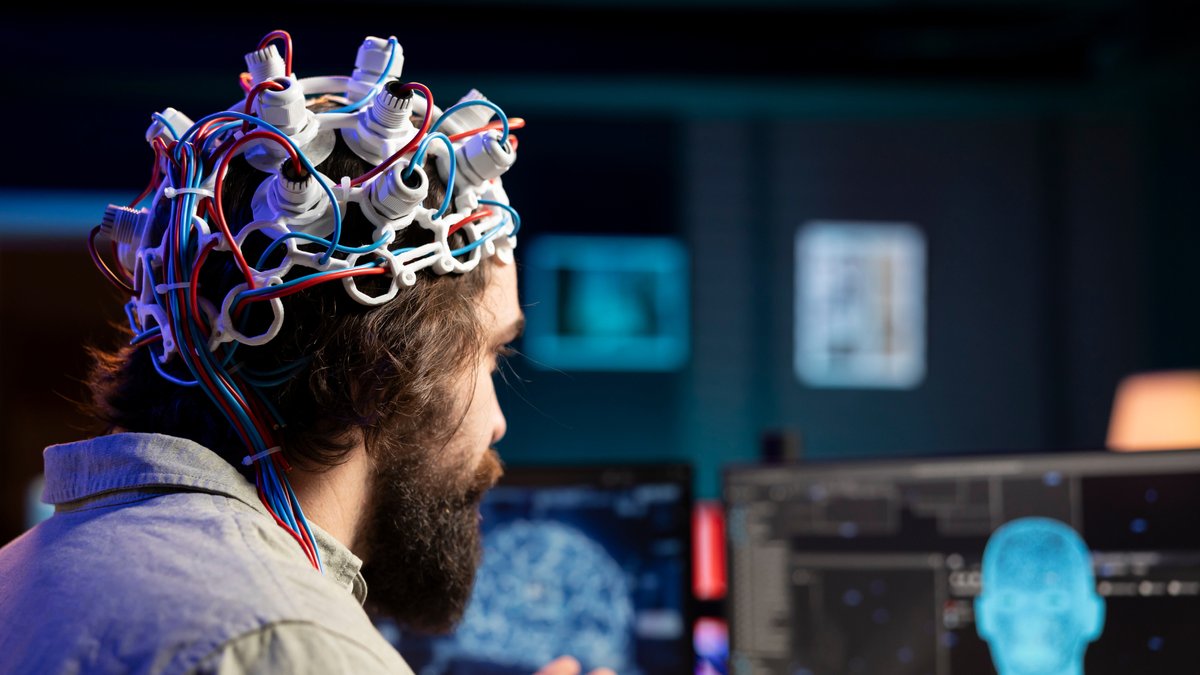
Elon Musk’s Neuralink, along with several other startups, have been experimenting with brain-computer interfaces (BCIs) for years now, allowing patients who have lost mobility to control computers using their minds alone. However, most of these require invasive surgery to install the sensor needed to detect brain signals. Meta is working to change this with its Brain2Qwerty non-invasive BCI. Instead of relying on implants, this system uses a non-invasive magnetoencephalography (MEG) scanner to read the faint changes in a brain’s magnetic fields due to brain activity and then correlate this to keypresses on a virtual keyboard.
The latest release is actually the second version of the non-invasive BCI, with the first one released last year as proof of concept. This second version has significantly increased accuracy after it was trained on ten times more data for each test subject. The company says that its average accuracy now hits 61%, with the best participant capable of hitting as much as 78% word accuracy. By comparison, the previous version only had an average of 40% accuracy, while the best user only achieved 48%.
While this sounds like a big improvement, Meta concedes that this is still not good enough for clinical testing. The 61% average accuracy still feels hit-and-miss and would be difficult to use in everyday conversation. Nevertheless, the company says that it plans to use more data for training the system, and that it’s continuously getting better results from it so far. Another issue it’s facing is the size of MEG sensors. Current MEG technology requires massive hardware — even larger than the user and the chair they’re sitting in. There are promising advancements in MEG sensors, though, which could result in smaller devices that are more manageable to use in clinical settings.
Meta’s non-invasive BCI alternative to Neuralink and other solutions that require brain surgery is still a long way off from allowing patients to control a webcam and play World of Warcraft. But it is still an important development in neuroprosthetics, and it could eventually result in medical devices that patients could use to restore or improve their quality of life. Meta isn’t the only one working on BCIs that don’t require major surgery — a team from Georgia Tech has also developed a tiny BCI that could be easily slid under the scalp, while Valve founder and superyacht enthusiast Gabe Newell also built a startup intent on creating a BCI that doesn’t require a battery.

Follow Tom's Hardware on Google News, or add us as a preferred source, to get our latest news, analysis, & reviews in your feeds.
Get Tom's Hardware's best news and in-depth reviews, straight to your inbox.
Jowi Morales is a tech enthusiast with years of experience working in the industry. He’s been writing with several tech publications since 2021, where he’s been interested in tech hardware and consumer electronics.
What's Your Reaction?
 Like
0
Like
0
 Dislike
0
Dislike
0
 Love
0
Love
0
 Funny
0
Funny
0
 Wow
0
Wow
0
 Sad
0
Sad
0
 Angry
0
Angry
0










Comments (0)