

‘Ocean with David Attenborough’ Director Keith Scholey Explains Why Everyone Should Be Hopeful About Ocean Conservation
The world of environmental conservation is vast, but director Keith Scholey’s Emmy-contending National Geographic documentary “Ocean with David Attenborough” makes a convincing case that ocean advocacy deserves a spot near the top of your priority list.
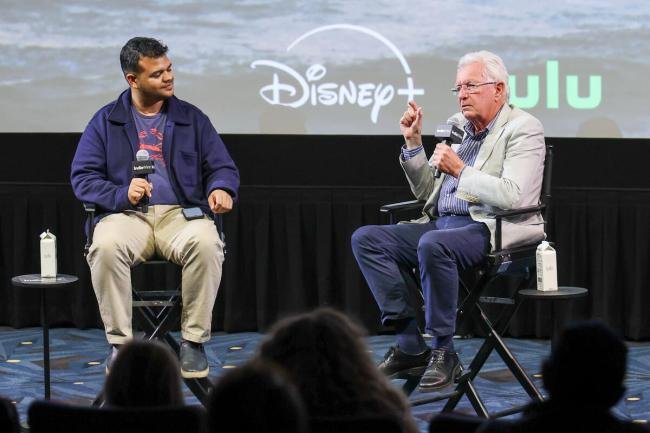
The documentarian recently shared his experiences at a special Pass the Remote screening of “Ocean” at Vidiots Foundation in Eagle Rock. Presented by Disney, the screening was followed by a conversation between Scholey and IndieWire awards editor Marcus Jones that shed further light on the vital role that oceans play in our planet’s ecosystem.
“Before I made this film, I knew that ocean conservation was important and could have a big impact. But I had no idea of the speed or scale of the impact it could make,” Scholey said. “And that became so clear while making the film. I knew the theory, but I didn’t know the practice.”


While many environmental documentaries are forced to share unpleasant realities about the state of our planet, “Ocean” is notable for leaving audiences feeling hopeful due to its information about oceans’ remarkable abilities to heal themselves. Scholey admits that even he did not understand the scope of the phenomenon before he made the film.
“I knew about the number of examples. I didn’t know about the range and how universal it was, and how quick it can happen,” he said. “That was the exciting thing when you realize ‘Oh, we’re onto something.’ People need hope these days, and in the ocean, it’s not false hope, it’s real hope.”
But the incredible powers of nature do not absolve humanity of our obligations. The film also calls for more human intervention to protect ocean species and ecosystems — something that Scholey argues is easier than other forms of conservation.
“Conservation on land is really hard, because people live on the land and you’re always in conflict,” he said. “Conservation in the sea doesn’t need to be hard. Most of it is done by people signing treaties, and the stroke of the pen.”
He continued, “When I was a student studying zoology at university, and I started in 1975. And at that time, whales were just gonna be hunted to extinction. And for what? Three nations and a couple of tiny companies were just going to remove the great whales of the world. It was mad. And with the stroke of a pen it was ended, and now we see all the huge benefits. It can be done.”
Much like the ending of his film, Scholey left the audience on a hopeful note, explaining that ocean conservation is the kind of goal that should unite all of humanity.
“We all own the sea,” he said. “It doesn’t belong to politicians or the fishing industry or what have you, we do. So leaders have to do what’s right for us.”
Watch the complete Pass the Remote conversation with Scholey in the video above.
“Ocean with David Attenborough” is currently available to stream on Hulu and Disney+.
What's Your Reaction?
 Like
0
Like
0
 Dislike
0
Dislike
0
 Love
0
Love
0
 Funny
0
Funny
0
 Wow
0
Wow
0
 Sad
0
Sad
0
 Angry
0
Angry
0





Comments (0)