

'We Own More Cameras Than We Have Employees': Inside Capture One's Hasselblad Deal
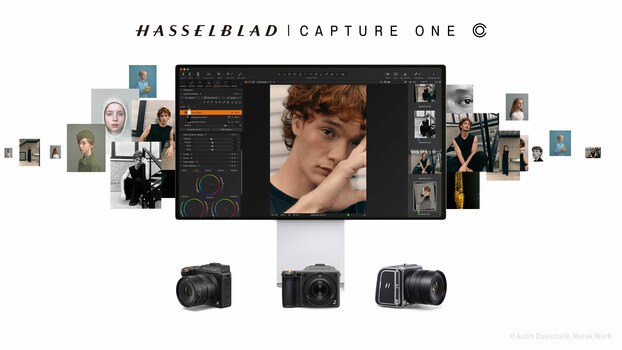
The announcement itself was straightforward enough. On July 2, Hasselblad and Capture One confirmed that Hasselblad's .3FR raw files now open natively in Capture One, with dedicated color profiles for the X2D II 100C, the X2D 100C, and the CFV 100C digital back, and lens profiles covering 19 XCD lenses. Tethered capture is planned for later in 2026. After years of forum threads and feature requests, the wait ended with a software update.
What the press release could not tell you was what the work actually looked like. So I sat down with Rafael Orta, Capture One's CEO, to ask.
What follows is a conversation about camera cabinets, a senior software engineer who has spent more than 30 years shaping Capture One's camera calibration and color, and why Orta says his roughly 120-person team sits behind a remarkable share of the images people encounter every day. It has been lightly edited for length and clarity.
The Wait
Alex Cooke: This has been one of the most requested features from photographers for years. What did it feel like when you finally got to say yes, and what made this the right moment?
Rafael Orta: Capture One offers support for more than 550 cameras across many different brands and manufacturers, so it's always a delight to introduce a whole new brand to Capture One users. The way we think of Capture One, and this is especially true in the last few years since we've been an independent software company, is as a tool that offers great flexibility to photographers to work with whichever hardware, even other software tools, they prefer to use. We are by foundation a Danish company, so quite often we use the analogy of being like a set of LEGO bricks that allows photographers to create workflows in the most flexible way, whatever they need for the type of shoot they have. Many of our customers shoot many different disciplines.
At Capture One, there's a very large population of the team who are very, very deep camera nerds. Getting our hands on a new camera and taking it out for a spin, taking thousands of frames with it, is something that is really exciting for us. We have many camera cabinets in the office. One of the interesting factoids about Capture One is that we own more cameras than we have employees. That's the type of camera company that we are.
Building the Profiles
You built dedicated profiles for each Hasselblad model rather than a generic one-size-fits-all approach. Hasselblad is known for its color, and its shooters expect high fidelity to the camera itself. What kind of craftsmanship did that take?
One of our team members, Niels Knudsen, has been with Phase One and now Capture One for 33 years. He was part of the very early crew that established Phase One, and over the years he's made huge contributions. I would argue he's made huge contributions to the photography industry in general. He is the person who fundamentally developed the foundations of what you'd call today the image quality and the color profiles, the way we think about color science at Capture One.
It's an involved process. It involves taking hundreds, and in some cases thousands, of pictures in controlled environments, in the same way, using the exact same objects. Then we craft these profiles to represent colors in an incredibly faithful way. It also has an element of taste. We do have our own taste in colors. Part of it is precision of color, but part of it is also how pleasant these images look.
Then we start iterating. We create a profile, we build an alpha version of Capture One, an internal build, and we send it to Hasselblad. They have a look at some files and we start collaborating on how we want these images to be represented in Capture One.
The other thing that is incredibly important when we build these profiles, and this is part of the process, is how the image looks once you start to pull sliders and apply adjustments. How do we make sure that what those adjustments are showing is a faithful representation of what we believe an adjustment in contrast or exposure should be? If you're lifting the shadows, how should it look, and how should that data be represented? It's quite a significant effort.
We say quite casually that we support more than 550 cameras. But that also means we only support cameras we have held in our hands, which explains why we have camera cabinets with hundreds of cameras. When we say we've built a profile for a camera, it's because we've spent a lot of time with it. It may be a number of team members, but it's also specifically Niels and a couple of other people who have this very, very deep specialism in how to represent sensor data in a way that is faithful to our standards for image quality and our color science.
If you want to get more out of the software Orta is describing, Fstoppers offers The Complete Capture One Editing Guide, which walks through the editing tools these profiles feed into.
That explains a lot about why the color is so good.
We have a couple of videos we've published that give a little bit of insight into that. But as a general thing, I've experienced this firsthand when we have a photographer in our office using Capture One for the first time, and they show up with an SSD and they open their first file. We see it in their eyes, that moment when they see the detail that Capture One reveals and the way Capture One presents colors. To be honest, that's the greatest satisfaction we can ever have, seeing a photographer's face responding to one of their images and where they can take it from there. Because ultimately, Capture One gives the photographer a great degree of control so they can start making adjustments to get close to what they want their own image to be.
Tethering as a Window
Tethered capture is planned for later this year, and Capture One is famous for having the best tethering in the business. Hasselblad is a medium-format brand, so a lot of their users work tethered in studio. What are you most excited to deliver when their shooters get that live, on-set experience?
In a way similar to how we think about our image processing pipeline and our color science, when we think about camera connectivity, it's based on a handful of engineering principles. Firstly, we have to be able to transfer data and display images fast. Secondly, it has to be reliable, so we have to know that every frame that is taken is going to show up at the workstation. And thirdly, it has to be stable, because some of these shoots might last for hours. There might be camera battery changes, lens changes along the way.
Ultimately, the way we think about the technology we build is that the technology has to fade into the background. What really matters is the creative process. That should be at the forefront, and people should almost forget they're using Capture One. They should plug here, plug there, and it just starts working and never stops working. That's a very engineering-centric view of the world.
When we think about the tethered workflow, the main thing we're trying to solve is how a team works together around a photography workflow, around the creative process. Internally, we describe it as opening a window into the mind, into the vision that the photographer has. The photographer is holding the camera, bringing it to their face, and then there's a team surrounding that process. There might be a stylist, an assistant, sometimes a client. The model is part of this team as well.
What we want is to show those files as quickly as possible, whether on a local screen, on an iPad, or on our cloud collaboration platform, Capture One Live, so it can fuel that creative process that is naturally a team effort and naturally multidisciplinary. Each individual in that team plays a different role, and they have their own voice.
Quite often tethering is reduced to, "oh, you connected a camera to a device." But we have a far more elevated view of tethering, which actually explains some of the technologies we build. For example, a couple of years ago we launched a capability called ReTether, which allows someone shooting tethered to disconnect the cable, go around a corner, take a few snaps, come back, reconnect, and then we pull the files that are missing from the session. Or more recently, when we launched the latest generation of our wireless capability. What it tends to do is help teamwork in ways that are very flexible to suit their needs. Ultimately, it gets people involved in the photoshoot, and that's exactly what we want.
For photographers building a studio workflow around these files, Portrait Retouching: Capture One and Photoshop covers moving images between the two applications.
The 100-Megapixel Files
People tend to underestimate how complex tethering is from an engineering perspective, so that's good insight. Now that native support exists, which improvement do you think Hasselblad shooters will feel first?
We're looking forward to seeing what photographers produce now that we're supporting the three Hasselblad cameras. I've already seen some of the reactions on social media, that initial moment when they open a file for the first time and get that reaction of, this is what this looks like when it's processed through the Capture One image pipeline. The feedback has been very positive in terms of being able to work with these files. We have a huge number of users who are using Capture One and maybe using other software for their Hasselblad files. And then the other thing is once they start being able to work in teams and work in studio. Seeing the incredible work they're going to create, that's really what we're looking forward to.
The three launch models all use 100-megapixel medium-format BSI CMOS sensors with 16-bit color depth. I've worked with Hasselblad's 100-megapixel files a few times, and they're unbelievably beautiful. What did you notice working with them in Capture One?
Every camera is a little bit different. Every manufacturer brings something different to the table. But without a shadow of a doubt, number one is the way we can represent colors from the Hasselblad devices in a way that has the Capture One color science but also brings to life the character that the camera has. And in general, working with these super-high-resolution sensors gives you the ability to create interesting compositions that you wouldn't be able to with other devices.
Those are the types of things that come up whenever we grab one of these cameras and start taking test shots around the office, or sometimes people will borrow one of these devices for a weekend. It's always super interesting to see what they come up with. With this one, though, it was very confidential until the moment we announced it just over a week ago. So there weren't that many moments when people were taking them out for a trial run over a weekend, which is something we can sometimes do with cameras that have already been announced.
Where the DNA Comes From
Beyond the technical fit, was there a shared philosophy or sensibility that made this collaboration click?
I came to Capture One five and a half years ago after a long career in tech and software, but joining Capture One was when that really intersected with the photography industry. So I joined Capture One and the photography industry at the same time, and it's been fascinating to learn how there's a collection of Scandinavian companies, which of course include Phase One and Capture One, but other brands of great stature like Imacon, which merged with Hasselblad in 2004, and Hasselblad itself, and also Profoto, and more contemporary companies that are more like startups. It's fascinating to see that there are companies with a very deep sensibility and understanding, and a very high degree of specialization, in areas related to photography and imaging in general.
This comes from a very long history of very high-quality printing in Denmark, specifically. Seventy or 80 years ago, the Danish print industry had developed significant capabilities to reproduce color in print, and very high-quality images in very sophisticated ways. That's the industry that eventually started to translate into print photography, and then eventually that became scanning and reproduction of prints into digital formats. When you trace back where the DNA of companies like Phase One and Capture One comes from, if you walk it back far enough, it comes from that industry.
We are a Danish company and our headquarters is in Denmark, but the reality is that our business is global. The majority of our business comes from the United States. We have large markets in the UK, in Germany, in France, and also in Japan. It's really fascinating to see that all of these markets are being served by this long lineage of people tracing all the way back to being able to render high fidelity of color and quality and detail. That becomes the institutional memory of a society.
Because of the role that Capture One plays in fashion photography, in commercial and advertising photography, in entertainment, and in the last couple of years in photojournalism, and then in the last 10 years or so with the growth of e-commerce, it is always a little bit humbling to think that you may be walking past a bus stop and that poster you see, which might be the key art for a movie or for a Netflix show, will have been created using Capture One. Your favorite e-commerce website, most of that imagery will have been produced using Capture One, and the same is true on social media, and the same is true of the Super Bowl and the World Cup. Many of those images have been processed using Capture One.
So we're always conscious that we may be a company of 122 people, but we serve a very large industry that creates very influential and very valuable images. And we're standing on the shoulders of giants, because people like Niels, who's been with the company for 33 years, was truly a pioneer in developing this very specialized knowledge on how to treat images and do it in a very consistent way.
What the Platform Becomes
For a company of roughly 120 people, the reach is remarkable. Capture One already supports over 550 cameras. Now that you're welcoming Hasselblad, what do you want the platform to be for professional photographers going forward?
There are a couple of things. The first is we spend a huge amount of time speaking to professional photographers across every imaginable discipline. It's incredibly important that whenever we speak to a photographer, they have confidence that we're serving their needs in the best possible way. Something else that is incredibly important for us is that they feel comfortable advocating for Capture One, because one of the stories we hear on a recurring basis from established photographers is how there was one day when they started assisting a commercial photographer, and that's when they discovered Capture One. It was the advocacy of the industry and the advocacy of established photographers that keeps fueling Capture One's position as the industry standard. So it's incredibly important that photographers see us as part of the industry, and see us as a company that has been built in support of their photography practices and their workflows.
The second thing is that there's an industry that is moving. I've only been in the industry for five and a half years, but in that time it has become very apparent to me that what the industry is today is different from what it was five years ago, and most certainly different from what it was 10 or 15 years ago, and never mind 20 or 25.
We play a very specific role, which is that we bring this software to the industry. We see it as our role to incorporate new technologies in the same way we did 20-plus years ago when the commercial industry was transitioning from analog to digital. We have been doing that for our whole history and we continue to do it today. I imagine that in five years, and in 10 years, there will be a photography workflow that looks quite different from what a photography workflow looks like today, because the tools will have evolved both from a hardware and a software perspective, and even the environments will have evolved. That's the role we see ourselves playing. We introduce software innovation into the photography workflow. The reason we are so uniquely positioned to do that is precisely because we have the sensibility of a photography company. It happens that our contribution to the industry is software, but we always start from the perspective of photography as a discipline.
The First File
Last question. When you imagine a Hasselblad photographer opening one of their files natively in Capture One for the first time, what do you hope that moment feels like?
I've started to pick up some signals of this through social media, but I hope the moment is a wow moment. I hope they discover an image that is a great starting point for the place where they want to go with that image. I hope they see that the detail has been rendered with great fidelity, and they discover that they can make adjustments and treat colors, and that it's just always going to look great. I hope it keeps bringing that sense of joy and that sense of fulfillment and that sense of discovery to the photography process.
Ultimately, the vision that the photographer has for that image they took is the thing that is central, because we always want the creative process to be the thing at the forefront. We want people to get a little bit lost in their creative process without thinking about the surrounding technology or the surrounding tools. We just want them to be in flow. If, when they open the file, that's the thing that starts to pull them into that flow state of image processing, then I think we will have done a good job.
Anything else you'd like to add?
Just that we appreciate that support for Hasselblad cameras has been very highly requested by the industry and by many of our users, and we are absolutely delighted that between us and Hasselblad, we could collaborate over the last few months and bring this to market. Of course, we started with file support, because we had it ready, and we're always trying to push anything we have ready out to be available as soon as it's ready. Tethering connectivity support is going to come later in the year, but most certainly before the end of the year. We can't wait to see the incredible images photographers are going to create with Hasselblad cameras and Capture One.
Native Hasselblad raw support is available now in Capture One 16.8.3 and Capture One Mobile 3.3.4, covering the X2D II 100C, the X2D 100C, and the CFV 100C digital back, along with lens profiles for 19 XCD lenses. Tethered capture is planned for later in 2026. Capture One is offering a free seven-day trial.
What's Your Reaction?
 Like
0
Like
0
 Dislike
0
Dislike
0
 Love
0
Love
0
 Funny
0
Funny
0
 Wow
0
Wow
0
 Sad
0
Sad
0
 Angry
0
Angry
0










Comments (0)