

Whales Are Dragging Fishing Line Across the Pacific, and Your Photos Can Help Save Them
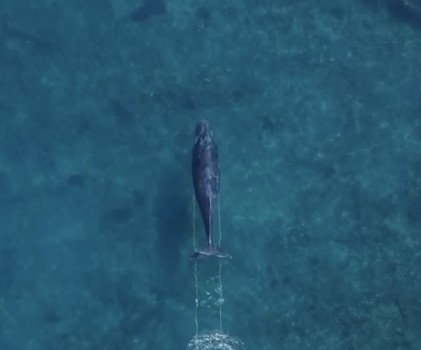
In the first two weeks of July, humpback whales turned up trailing fishing line on both sides of the Pacific, and rescue teams scrambled to reach them. Some whales were freed, some vanished before responders could find them, and at least one died.
According to Divernet, the worst cluster hit Ningaloo Marine Park in Western Australia, a place divers usually associate with whale sharks. Local reporting says the DBCA received up to five reports of entangled whales off the Ningaloo coast between July 5 and July 10, though it noted that some sightings may relate to the same animal. One case was grim: on July 8, responders located a nine-meter humpback that the department described as "emaciated and heavily embedded in entanglement," attached a satellite tag before dark, and planned to return the next morning. The whale died overnight, and its carcass washed onto the reef at Mandu, drawing sharks and forcing two beaches to close.
The rope tells part of the story. "We're seeing a lot of rope consistent with commercial fishing gear like crab and cray pots, and there's a lot of uncertainty as to where they're coming from and why there's more this year," the Balu Blue Foundation's Brinkley Davies told ABC News. That uncertainty is the hard part. An entangled humpback can cover tens of kilometers in a day, so a whale reported one evening can be miles offshore and gone by morning. The foundation runs a wildlife rescue hotline in the area and leans on water-users to keep eyes on the animals.
The Ningaloo whales were not alone. On July 4, a humpback got caught in a Gold Coast shark-control net and needed a four-hour operation, with Queensland Fisheries' Marine Animal Release Team and Sea World Foundation rescuers completing the release the next day. New South Wales reported more entangled humpbacks during the migration. Across the Pacific off British Columbia, a well-known whale nicknamed Pop Tart trailed hundreds of meters of line for almost a week near the Canada-U.S. border. Whale-watchers first flagged its distress on July 2, but weather delayed the work, and the Pacific Whale Watch Association's response network did not confirm success until July 10. During that same period, the Hawaiian Islands Humpback Whale National Marine Sanctuary announced that it had cut two additional humpbacks loose from gear that threatened their lives.
Here is where this becomes your story. Rescuers repeatedly say the single most useful thing a bystander can do is report fast and document well, not grab a knife. In Western Australia, only trained and authorized responders are permitted to attempt disentanglements, and the DBCA warns that a well-meaning cut can be dangerous and can delay a proper rescue. What the foundation requests is precise: should you spot an animal dragging line, floats, or buoys, or simply acting strangely, capture it on video or in photos, log a GPS position, take note of the way it is traveling, and alert authorities without delay. NOAA gives the same guidance in U.S. waters, adding that photos or videos from a safe, legal distance, greater than 100 yards for humpbacks, give response teams real information to work with.
Your frames are more than pretty pictures. They help identify individuals, show exactly how the gear wraps, and let responders track a whale that would otherwise disappear. This is a large-scale crisis. The International Whaling Commission estimates that more than 300,000 whales and dolphins die each year from bycatch and entanglement, and humpbacks are especially vulnerable because their long fins and coastal habits put them in the path of gear. The whale named Starry Knight in the Salish Sea shows how repetitive this can get: freed from a life-threatening entanglement in July, it was found snagged again in a nearly identical spot weeks later, the new line digging into wounds that had not yet healed. When you photograph a whale trailing rope, shoot the wraps, the floats, and the direction it is heading, get the coordinates, and make the call. That image may be the reason someone finds the animal at all.
What's Your Reaction?
 Like
0
Like
0
 Dislike
0
Dislike
0
 Love
0
Love
0
 Funny
0
Funny
0
 Wow
0
Wow
0
 Sad
0
Sad
0
 Angry
0
Angry
0









Comments (0)