

With Star Wars: Galactic Racer, former Burnout devs have built on a PS1 classic to make what they call "the purest expression of gaming"
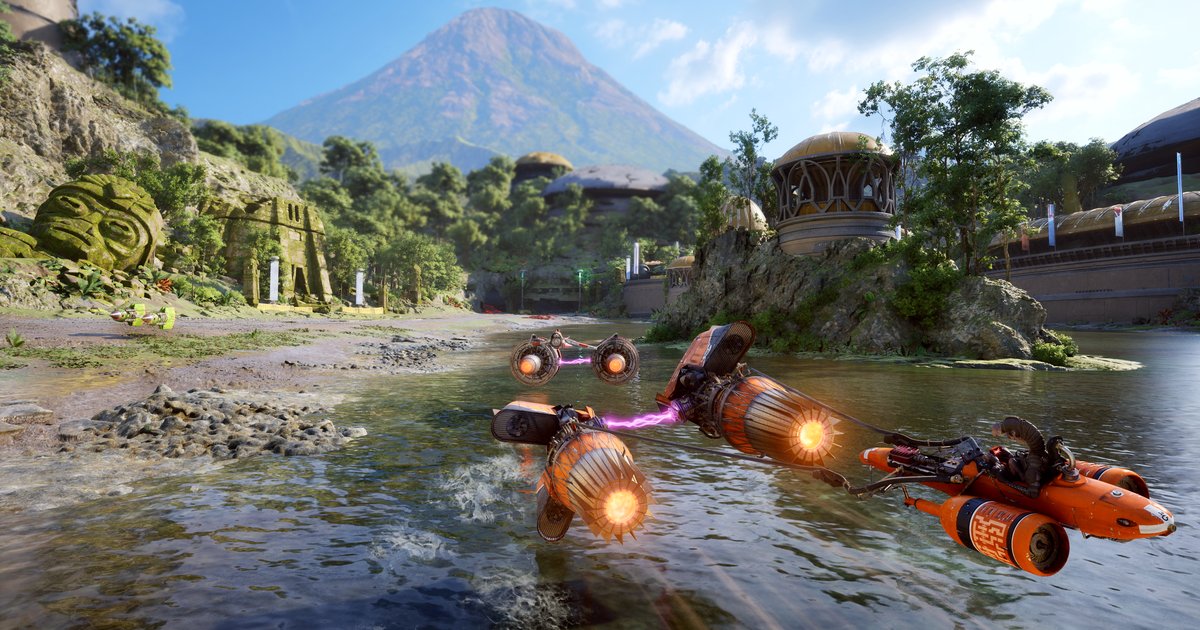
"Racing is crying out for a bit of consequence," says Matt Webster, Fuse Games' founder and CEO, and former general manager at Burnout and Need For Speed developer Criterion. "Crashing is consequence - not just the visual and the audio spectacle of it; we learn something from it. It's tough to have consequence when you've got a rewind button."
If there's something to take away from Star Wars: Galactic Racer, it's that the developers at Fuse Games really like a good crash. And you will probably have to learn to love a good crash too if you're going to play Galactic Racer, because here's the big twist: it's a roguelite - or a "runs-based game" going by Fuse's terminology - where only a little bit of progression carries over between each attempt. And that means failing, i.e. crashing, is kind of the whole point.
The good news is, crashing in Star Wars: Galactic Racer is great. Arms flail, parts spin and fizz like catharine wheels as they fly off over the horizon, racers curse you archly and pods, speeders, and bikes go boom. "We talk about Star Wars - a race should feel like a bar fight," Webster laughs, talking to me here back at Los Angeles' Summer Game Fest. "Star Wars gives you a wonderful license for that, but it's got this funky– a bit of a dark underbelly in Star Wars, where you've got the criminality, you've got the syndicates–" it's a "rough and tumble universe," interjects Kieran Crimmins with a laugh, also formerly of Criterion and now creative director at Fuse. "More than rough and tumble!" continues Webster. "Oh my god the podracing in Episode One, it was brutal! And so let's bring some of that into it - and that's what puts a smile on your face. Elbows out racing, putting someone into the wall is the way you get ahead…"
It's a cracking experience in practice. Star Wars: Galactic Racer is a blast, an authentically old-school kind of arcadey racer in many ways, with absolute immediacy of mechanics - there are only a few really, with a couple abilities I'll get to in more detail - and an emphasis on spectacle, aggression, sensation. I joked with the Fuse developers about bowieknife99, the Forza Horizon 6 drivatar that shot to infamy earlier this year after relentlessly hunting down players and driving them off the roads. Their response was that this kind of driving is already built into Galactic Racer. "I would say we've designed this game for aggressive racing," Crimmins said, "so it isn't something you can mess up the game with. It's part of the mechanics, it's part of the abilities that you can have, it's a legitimate playstyle that actually makes that kind of play really, really fun."
The tension here - because it is very tempting to just ram players with abandon, often subsequently taking yourself out in the process - comes from the structure of Galactic Racer's campaign. It's a roguelite, insofar as your task is to get as far as you can into the Galactic League, ideally winning it, before you get smashed to bits and go again. You get a race token from your mechanic mate - I'm not going to try to remember another Star Wars name here I'm afraid, sorry; call him Blorb Blorgo (okay I felt bad and looked him up and it's Darius Pax, whatever) - and you lose it when you crash out of a race completely.
You get some lives within a race, typically about three crashes in my experience, and you can likewise lose your token for finishing outside the top three places. How high you finish, and whether you complete any other little side objectives, dictates the quality of your rewards. Spend your rewards on upgrading your ship to improve; keep winning; happy days. Stop winning and you're outta there, and it's back to the beginning. The events - different kinds of races with varying twists and stakes - are randomised with each run, however, though the order of the planets they take place on is fixed. Part of the variation is in choosing a path along a horizontally branching tree, a lot like a fancier-looking version of navigating between sectors in FTL: Faster Than Light (and if you don't get that reference, sort it out immediately).
This campaign structure is one of those "I can't believe they haven't done it before" mashups, the kind it feels is only getting rarer as video games mature. You're planet-hopping between some recognisable locations - Jakku makes a return for instance - and engaging in a little metagame as you go. Take a step back and you realise this is actually one if video games' best, and for me most underutilised campaign modes making a return. It's Galactic Conquest! A casual single-player mode that gives individual, replayable scenarios a sense of consequence - there's that buzzword - and meaning beyond the bout itself. And such a smart fit here, in fact, that I'd potentially put it on par with the equivalent mode of the original Star Wars Battlefront games. "I've noticed today, when people are racing, they sit a little bit more forward into the race, they lean in, they're starting to think about the race, because we've got that consequence of crashing," Webster said, looking over at the booth beside us as someone very nearly crashes out.
Much of this, Webster and Crimmins continued, comes from a genuine desire to do something new within the genre. "It's like lightning in a bottle sometimes," Webster said, when I brought up Burnout Paradise specifically, and how hard that game's been to surpass. "When we were making Burnout games, we were always trying to push something forward, do something new - like Paradise, to your example, all we'd ever made was an arcade racer, a track-based racer. So what is the expression of that in an open world? There wasn't anything there, really, before then, and so there was a wonderful 'opportunity space' for us to be creative inside. Then we were making it up as we went along." The same logic then applied to Star Wars: Galactic Racer. "How do we push the genre forward? What's missing? Consequence is missing," Webster continued.
"How do we bring consequence into the structure? How do we have not just the consequence of crashing, but consequence in decision-making, like your build." Ultimately it came down to the same goal: "We want to move the genre forward, and so there's a lot of similarities with Paradise in that regard - in terms of how we try, a lot of the time, to just invent new cool stuff. That's what we're trying here, it just happens to be inside a Star Wars game."
In taking you across all those planets - including some I'm not allowed to mention in classic Star Wars video game fashion, Star Wars: Galactic Racer also forces you to adapt to various weather conditions in turn. And it ties in nicely with the vehicle builds you can create in the game. My demo wasn't long enough out at SGF to really dig into this in much depth, given I started my run from the very beginning, but the promise is of real complexity here. A combination of parts, upgrades, and abilities - as well as some visual customisation, I'm told - combine with 14 different 'racer styles' that modified your abilities as a racer and a number of different vehicle types as well: the landspeeder, speeder bike, podracers, and a new vehicle created for the game called a skim speeder, that can turn itself from horizontally flat to vertical, like switching from landscape to portrait, to corner more aggressively or sneak through thin gaps. Or, if you're like me, to crash - only much more melodramatically.
Crimmins described a "system with a combinatorics of parts that I believe I've never seen in a racing game before. The amount of different builds and the way that you can play this game - I think my designer said the combinatorics are in the trillions already. There are builds in here I haven't even seen." It's quite a claim, but if it comes together in the playing, which can only really be judged after a good bit of time with it, it's a system that could be really special. Webster felt the same. "I've not talked about builds [in a racing game] like I have in this game since I think Gran Turismo 2, where I'm like: that fly wheel, and this prop shaft, and this turbo…"
Some more essential info: there are four modes here, not only the campaign. Arcade mode is where you can play podracing, for instance, as well as in online multiplayer. I raced as good ol' Sebulba on the Episode One Tatooine track, which brought back some quite fierce memories of the classic Star Wars Racer Revenge on the PS2. That and the original that released shortly before on the NS64, Star Wars Episode 1 Racer, are genuine inspirations here too.
"It's a wonderful video game," Crimmins said of the original, "it's a video game I'm a huge fan of. I played it when it came out, I played it again after that, I played it at the start of this project again - which is kind of a treat really, to go back and play something you love. And a lot of the DNA of that game we translated into this game, particularly the pod events, the way they do their boost mechanic, some of the sense of speed that they got from those vehicles - because that's kind of the quintessential podracing game."
Those Star Wars racing classics offered "a lot of the original inspirations" for Galactic Racer, Crimmins continued. "It feels like for the campaign we've got a really authentic way of looking at that - and okay, it's more than just podracing, there's other vehicles in there, but pods do show up in that campaign in a kind of interesting way. They call back to that game in a way I think players are going to find really, really interesting."
All together, it feels like quite an authentic return to the form of classic arcade racers. And in a way the casual racer's had something of a mini renaissance recently, with the hangout vibes of Forza Horizon the de facto entry point for a lot of console players, the likes of Hot Wheels, Stuntman and Crazy Taxi all returning at this year's SGF, and even the kart racing genre re-emerging out of nowhere, across Mario, Sonic, and Kirby all last year.
"One of the reasons we've got an arcade machine in the office is because I think in many ways it's the purest expression of gaming," Webster said when I asked him about the genre having something of a moment. "In [that]: first of all, put the experience in front of this player immediately, have the joy of discovery of how things work, and have unexpected depth. Like one of my favourite games is Bomb Jack. Bomb Jack on the surface looks incredibly simple, but the depth of control there is unexpected, the depth of scoring, the mechanism inside there is like, you only know that by watching somebody… so for me when people say "arcade racing" it's the approachability, it's the fantasy fulfilment, very quickly - but it's not the absence of depth."
But even a basic, largely unaltered racer was a joy. Fuse have a knack for making environments whizz by with a certain, fine-tuned level of visual chaos, for building environments that are instantly readable, so your eye can start to optimise a path the moment you round the next bend in the track. There are jumps and short-cuts and occasionally tricky little obstacles to bump an enemy into or, more likely, get snagged on yourself to once again dramatically explode.
And what better way, after all, to convey all that arcade immediacy than with a good crash. As Crimmins put it: "We want people to hit people. We want them to crash in amazing ways. We want to make failure fun. All of that stuff we learned in Burnout," he goes on. "I'd say that crashing and visceral spectacle are in the DNA of the studio." From a first go at Star Wars: Galactic Racer, it certainly feels like it.
What's Your Reaction?
 Like
0
Like
0
 Dislike
0
Dislike
0
 Love
0
Love
0
 Funny
0
Funny
0
 Wow
0
Wow
0
 Sad
0
Sad
0
 Angry
0
Angry
0






Comments (0)