

The Two-Camera Wedding Setup That Actually Works
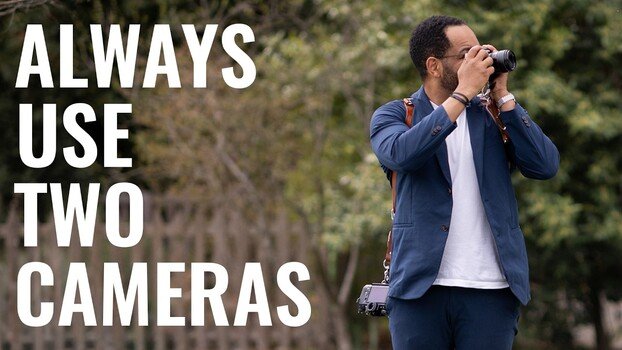
Shooting a wedding with one camera is a gamble. One malfunction, one missed moment, and there's no recovering it. That's the core reason most working wedding photographers carry two camera bodies, but the backup argument is only part of the story.
Coming to you from John Branch IV Photography, this practical video walks through Branch's full two-camera system for wedding days, starting with the case for redundancy. Branch makes the point bluntly: if your camera dies during the ceremony and your backup is in a bag across the room, you're out of luck. The first kiss doesn't wait. Wearing both cameras on a double strap, specifically the HoldFast Gear Money Maker, means a working body is always within reach. Branch also recommends shooting matching bodies when possible, and he runs either two Fujifilm GFX 100 II bodies, a GFX 100 II paired with a Fujifilm GFX 100RF, or two Fujifilm X-T5 bodies depending on the job. Same body means swapping lenses between cameras is seamless if something goes wrong.
The second reason for two cameras is speed, and it connects directly to shooting prime lenses. Branch shoots primes almost exclusively, and having a wide body and a tight body already set up means he's never hunting for a focal length when something happens fast. A wide prime like a 23mm (35mm full frame equivalent) stays on one camera, a longer prime on the other, and he pulls whichever one fits the moment. Prime lenses also offer apertures like f/1.2 or f/1.4, which matter a lot during dark reception halls where zoom lenses typically max out at f/2.8. The reaction shots Branch captures, parents tearing up, couples laughing, those come from being ready before the moment arrives.
Branch carries four lenses across his two bodies and a bag, generally a 16mm, 23mm, 33mm, and 50mm in Fujifilm crop sensor focal lengths, which translate to roughly 24mm, 35mm, 50mm, and 85mm in full frame terms. He designates each body by role: one wide camera, one tight camera. That structure lets him minimize lens changes throughout the day. He only swaps when the section of the wedding genuinely calls for it, not constantly. The video goes deep on exactly which focal lengths he uses for getting ready, the first look, the ceremony, speeches, the reception, and sparkler exits, with specific reasoning for each. That breakdown alone is worth watching. Check out the video above for the full focal length breakdown and live demonstration from Branch.
What's Your Reaction?
 Like
0
Like
0
 Dislike
0
Dislike
0
 Love
0
Love
0
 Funny
0
Funny
0
 Wow
0
Wow
0
 Sad
0
Sad
0
 Angry
0
Angry
0









Comments (0)